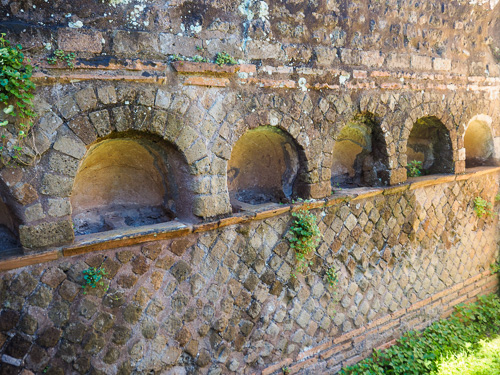

During antiquity Rome was the center of an empire that stretched from England and Spain to Germany and the lands touched by the Mediterranean Sea. Trade and commerce from former empires ruled by the Greeks, the Egyptians, Persians, and Carthaginians, Rome traded goods from distant lands. It was truly an international city, and its residents lived a life with the advantages of trading from around the vast empire. Sixteen miles away, situated on the Tiber and Mediterranean Sea was the town of Ostia. Ostia was Rome’s port. It was not only the landing place for goods from around the empire, but it was also a logistics hub for storage and transport to and from the capital city. During the millennia since Caesar’s reign, the old port has silted up making it look like it moved from the seaside. The foundations, walls, and even the old Forum remain. Those walls and foundations hold secrets to ancient trade and life in ancient Rome. They also hold stories from the not-too-distant Italy of Benito Mussolini.
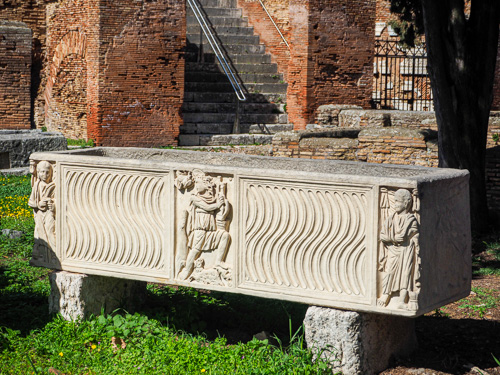

Only a short twenty miles from the ancient city accessible by an interurban train, the ruins of the city, now called Ostia Antica, remain an active archeological site. Entry to the town begins outside the old city gate in an area of tombs. While burials were forbidden inside the city walls, residents didn’t want to travel for the internment of their loved ones and relatives, so just outside the gate became the area cemetery. The few marble casks and many tombs are the first hint that this visit is not ready for Hollywood and Italy has not turned this into a Disneyesque experience. The quest to discover the workings of the ancient city are still under way. Even in this area restricted to the afterlife, the differences between rich and poor are evident as the sizes of tombs vary and descriptions of contents provided for the departed. Nearby signs assist the tourist in identifying the rich from the merely well off.
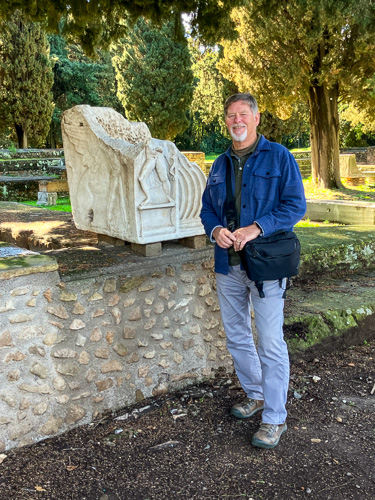
Passing the city gate but before entering the neighborhoods, rows of warehouses are displayed. With only short walls remaining, it can be a challenge to visualize the hustle of this port. The sheer number of rooms and buildings, all in decay, require a little imagination to make sense of the descriptions left for us, the 21st century visitors of a long dead city. Signs posted describe the various clay pots used to store grain and other loose items.
No Roman city would be livable without public baths. To the uninitiated the public baths with their different rooms for cold, warm, and hot water look identical to the ruins of the warehouses. A few minutes staring at the foundations and informational signposts helped me to visualize what the old city might have looked like. At this point a flipbook with the current ruins and layovers to build up the walls and roofs to what the town looked like in antiquity would have been helpful.

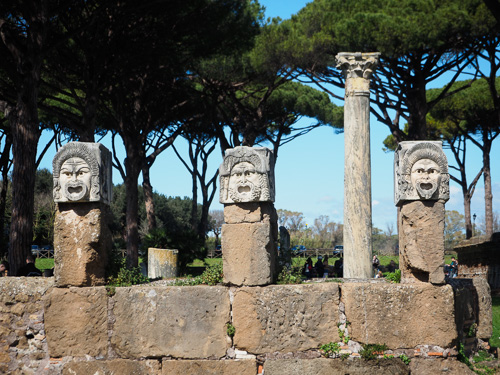
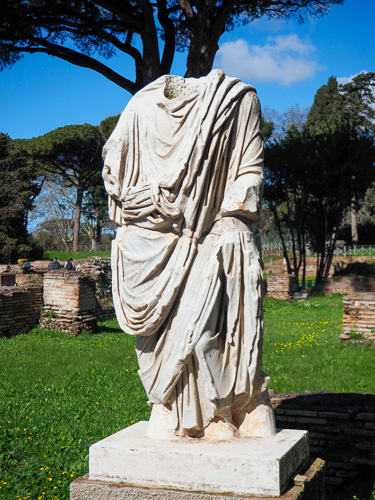
Past the baths of the old Roman street, no longer smooth as it was during the city’s heyday, the visitor approaches the government with its Forum for concerts and plays, and city hall. Archeological work began in the first decade of the 20th century. According to the material at the site, in the 1920’s and 30’s Mussolini’s government restored part of the Forum and hosted concerts for the public. For the fascists, linking Italy with the glory of Rome provided inspiration for a renewed, strong, and internationally important Italy in the 20th century. Both the Forum and the temple behind the stage were not only build on an older temple site but included new statues of Greek gods as inspiration, a reminder for guests that Rome adopted Greek culture and their pantheon of gods.


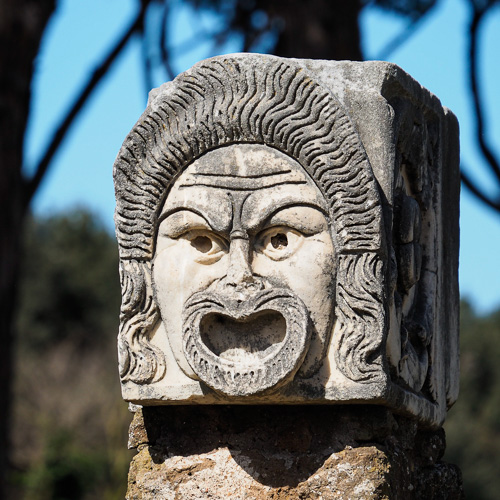
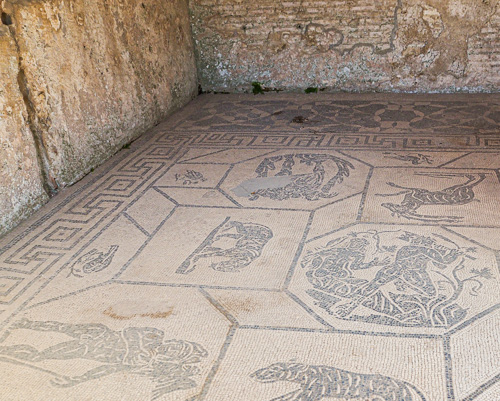
Moving on to the continuing work to uncover the past, in the residential section we viewed the ruins of a house built by a successful merchant. The footprint for the house was quite large, maybe 1800 square feet of first floor space which included living and eating quarters, a private chapel of some kind, bedrooms and some adjacent meeting room complete with a mosaic floor, dedicated to the gods that made the owner’s success possible. This floor, uncovered, was a rare site during our visit as most of the mosaics throughout the site were covered with a tarp to protect them during the winter. Even though the foundation of the house was large (it likely had multiple stories), it had no yard. I’d bet the owner could eavesdrop on the neighbor’s arguments.
As is frequently the case when I visit an historical site, my fellow travelers are done long before I am ready to leave. If I get the chance to return, I’ll start in the middle of the city where city hall was and move through the rest of the old port city. Even without traversing about one half of the old city, Ostia Antica was a highlight of our Roman Holiday.




 Talkin' about the past, photographing the present