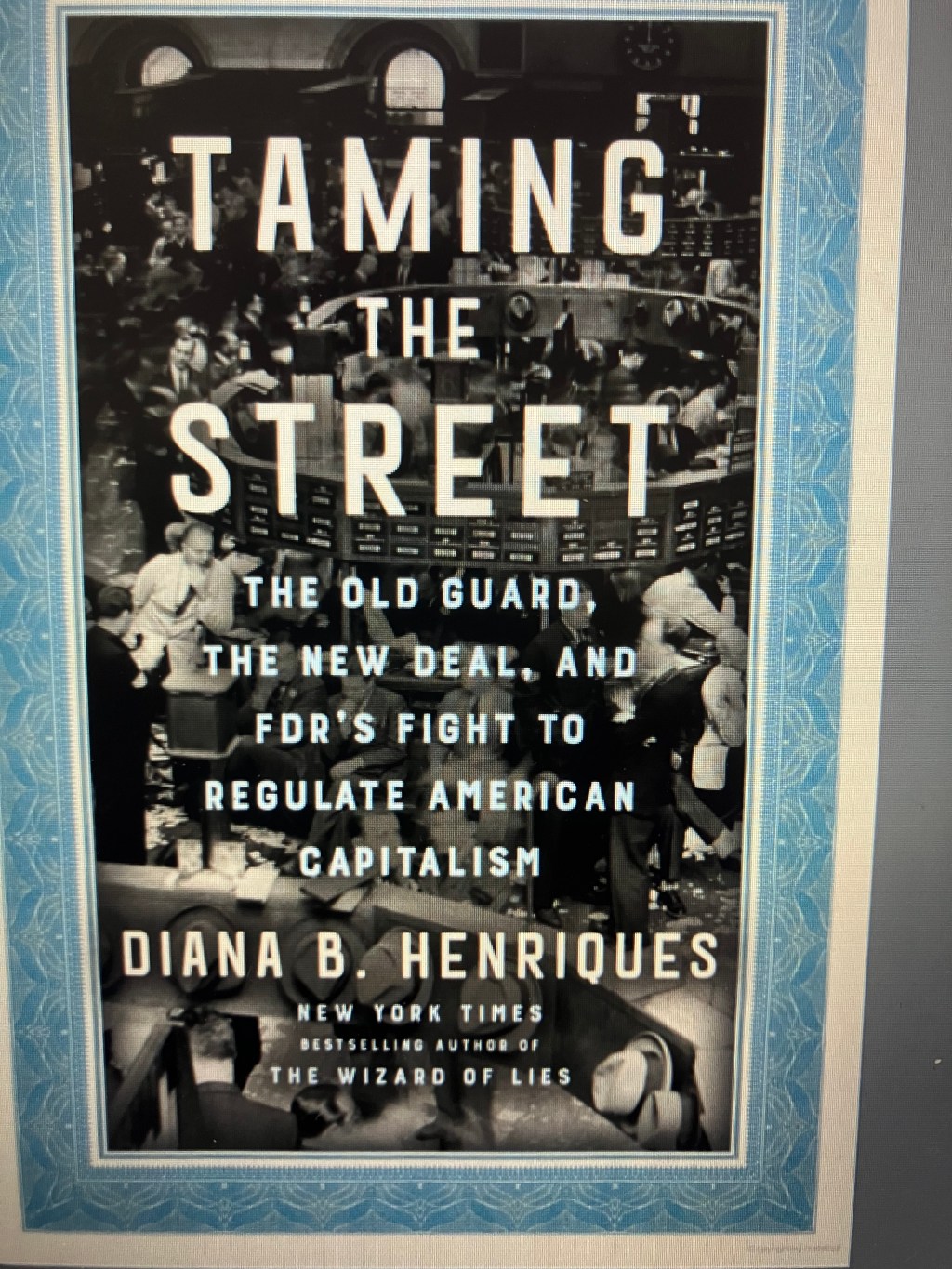
Who owns America? It might seem like a simple question at the onset. Delve a little deeper into the question and it becomes difficult to answer. Like a debate where the definition of the terms used during the session becomes the guiding guardrails to victory, the parameters of ownership might be the key to our question. Diana B. Henriques book, Taming the Street: The Old Guard, the New Deal, and FDR’s Fight to Regulate American Capitalism reveals the fight to gain control over Wall Street, its money, and the necessity to reign in the players. It helps answer the question we started with.
In the aftermath of the Great Recession, many Americans gained a deeper understanding about the financial crisis of their grandparents or great grandparents in the 1930’s. Corporate and personal greed caused of Great Depression. As the Roaring Twenties came to a close, the consumer and business bubble that inflated over the decade burst. It didn’t have to be “Great”. The depth of the recession was a consequence of a certain kind of greed. Diana B. Henriques addresses the greed of Wall Street and the successful actions by the Roosevelt administration to reign in the unchecked power of the money men at the beginning of the last century.
Henriques isn’t new to the subject. As a New York Times journalist and author of five previous books about money and the men who manipulate it, including two books about Bernie Madoff, her career of exposing graft and corruption has placed her as a finalist for a Pulitzer Prize.
It’s just another downturn in the economy; President Hoover must have thought. At least, that is how he acted. Another economic downturn that would right itself with a little time, like others before it, resulting in a hands-off approach to the economy. And like the two presidents before him, he thought government should keep their hands off. Unfortunately, the economy didn’t right itself. It needed a more direct hand. The voters agreed and not only swept him out of office, but they also cleaned Congress of the GOP’s decade long dominance. Instead, voters turned toward Franklin Roosevelt, former Governor of New York, who promised a New Deal.
Successful efforts to reign in the small group of men who directed the flow of money and company stock is the target of Taming the Street. Henriques weaves together a tension filled story of the battle between the newly formed Securities and Exchange Commission (SEC), and the individuals and old boys club that controlled the Stock Exchange. Needless to say, the cadre of titans on Wall Street resisted any restriction.
Of course, the titans on Wall Street promised to play nice after the crash. No regulation needed here, they demanded. Readers of this review will remember the second biggest crash in recent history, aptly named the Great Recession so as not to be confused with the crash of the 1930’s. Banks and investors making the same promises in the 2008 crash had no more credence than those from eighty years prior. Without government regulation, greed will always win over the public good. How the founding of the SEC played out included lies, a coverup, and a battle from the administration, through Congress, and back to the individuals and Wall Street organization makes for a compelling story, which Henriques delivers with aplomb. While full of details, her narrative is as compelling as any work of fiction. At the end I was reminded that you can’t make this up and fiction is just another way of exposing human nature.
This is a story of how the government changed from being “for the businesses” to “for the people” and established the modern state that protects the public from greed and corruption aimed at simply making the rich richer on the backs of the public at large. Echoed within the story of regulating Wall Street are the issues of regulating clean air, water, healthy food and controlling communicable diseases without squelching innovation and corporate profits. The concept, called Democratic Capitalism, is a caution against the return of unfettered greed without regard to people living today or the health of the planet that will sustain us and future generations.

 Talkin' about the past, photographing the present