
With a 2023 Gross Metropolitan Product of $782 billion dollars, greater Los Angeles is the 21st largest economy on the planet. One major reason for its strong economy is its harbor. Poised on the edge of the Pacific Ocean its moderate climate and extensive rail and trucking network, Los Angeles connects the rest of the United States to the products of the Pacific Rim. But the harbor at San Pedro (and its sister Long Beach Harbor) isn’t natural, it’s a created shipping center. Before the 20th Century it was an estuary with shallow channels that could only accommodate small boats at high tide. The estuary was a healthy ecosystem that supported indigenous people who lived in harmony with nature and traded extensively with other local people groups inland and the Channel Islands.
The story of its transformation from a shallow, muddy estuary to a deep-water port is professor of history with the California State University James Tejani’s subject in his new book A Machine to Move Ocean and Earth. Readers looking for a contemporary account of tonnage handled at the port will be disappointed and should look at reports and other contemporary sources. Instead, Tejana focuses on the sixty-year transition from the Mexican period of California when the estuary was still in its native condition through the rancho era and early American period, ending with the successful private and governmental expenditures that resulted in dredging the harbor right after the first world war.
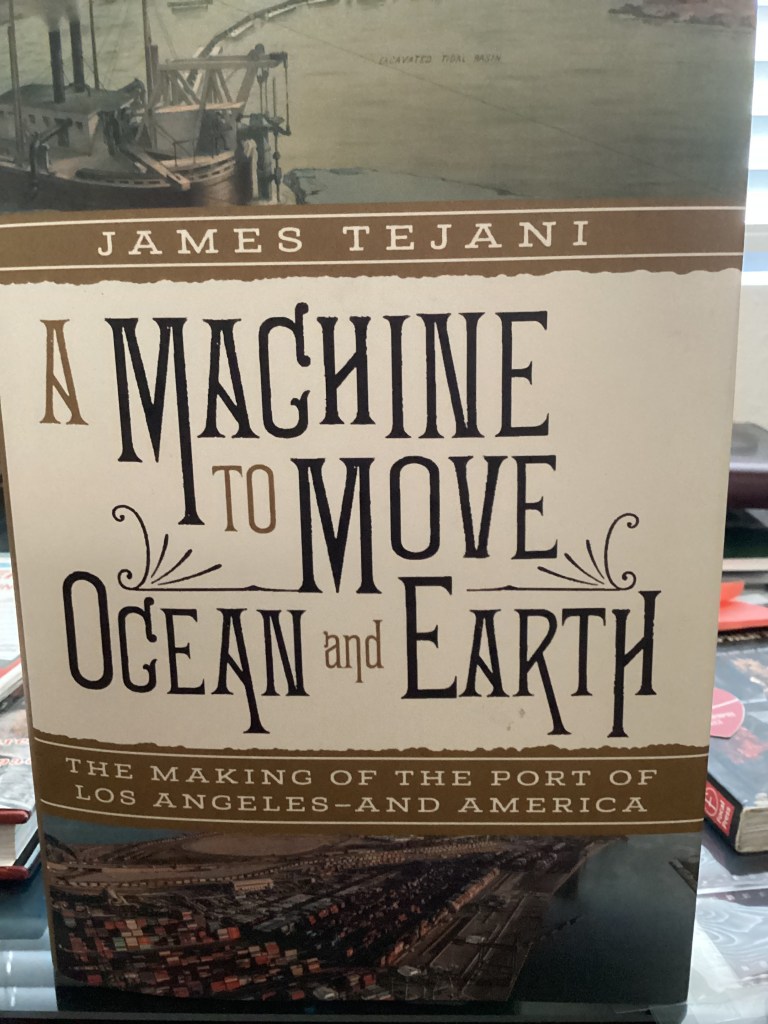
Tejani does a good job showing how big international events put pressure on Californios and newly arrived Americans to jolt the sleepy coast and water starved interior into the expansionist American Era. Ambition and opportunity combined with wars and Manifest Destiny to shape people and events on the far western frontier in 19th century America. Major wars in this time include the Civil War in mid-century and Spanish-American War at the end of the 1800s. The Civil War benefits from all the gold coming out of the ground in California and the Spanish-American War put the West Coast on the precipice of a new empire. These two wars enable major and minor players to create an American transportation hub even before the harbor became a reality.
The narrative begins in the American period when local Californios and the old rancho system are in flux as the new government is called upon to settle land ownership. At the same time the US set out to create a valid cartographic map of the entire west coast using new techniques that corrected for the earth’s curvature. Tejani spends considerable time explaining why the new survey is important, what it sought to correct, and how members of the survey team, a branch of the military, become involved in land speculation and new assignments because of the Civil War. The survey, which included the Channel Islands became a critical piece of information for the location of the harbor and its eventual dredging.Shifting coalitions and friendships of political and business convenience are woven into a compelling and convincing narrative. Some of the big players from the era came into play like E.H. Harriman and the Southern Pacific. Local business entrepreneur Phineas Banning plays a prominent role virtually establishing interior trade and transit routes by himself. His claim that San Pedro is truly a harbor plays a big role in the eventual establishment of San Pedro. A coalition of businesses under the umbrella of the Los Angeles Chamber of Commerce establishes the ways and means to successfully fight off the Southern Pacific and secure local and federal government funding for the dredging and construction of the harbor.
Tejani has his work cut out for him as he reveals the science required for an accurate map, property rights, both legal and topographic, and politics in the whole thing.
It would take a much larger work to include the extension of Los Angeles and its workforce, which was the consequence of the Pacific Electric trolley system that moved people and goods around the greater LA area. The Great Merger with Southern Pacific in 1911 brought together the emerging harbor, transcontinental rail lines and the local trolley people mover and creator of the great suburbs of Southern California making the harbor a true hub for transpacific trade. Workers to man the harbor were both agents of a successful port and customers for the imported products flooding into the port. This aspect of the growth of Los Angeles is outside of Tehani’s purpose.
The sacrifice from a natural estuary and the people it supported is the real theme of this book. The estrangement of the people from the natural habitat was complete by 1920. Tejani chooses this as a good stopping place for A Machine to Move Ocean and Earth.
There’s more story to tell about the impact of the harbor, the growth of a great city, and its influence on the country and the world. If he chooses to take the next step, Tejani is up to the task. His narrative style is easy going and his bibliography extensive. Perhaps he will follow up with something else in this area as the transition from sleepy Alta California to the economic and entrepreneurial powerhouse, one that has resulted in a communal amnesia about the people who were displaced by the activity he lays out in this book.
For those interested in Los Angeles’ founding, Tejani’s book is one more important piece of a puzzle that includes William Mullholand and Owens Valley water, fertile valleys turned into suburban housing tracks, and the make-believe industries that when smashed together create the world’s 21st largest economy.

 Talkin' about the past, photographing the present