
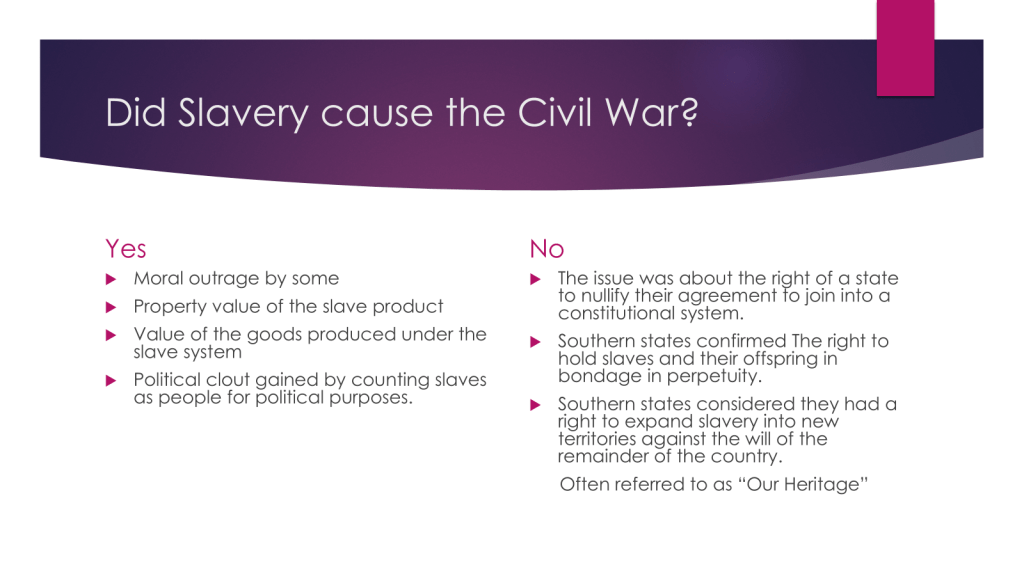
It seems like a question we all know the answer to, we learned it in high school. Slavery caused the Civil War. Why should we look any further? It turns out that the slavery we think about and the slavery Americans in the early 19th century thought about only have a few things in common. To us the morality of slavery is the one issue we associate with the institution whereby one group of people had the legal right to own another group. To Americans in the pre civil war period (antebellum period) morality was an issue for one group in society known as abolitionists. Even within the abolition group few thought African people were in any way equal to caucasians. To an overwhelming majority of Americans freeing slaves was not the same as giving them full citizenship and all the rights guaranteed in the Constitution. If civil rights was not the issue, how could slavery be the cause of the conflict? The Lost Cause narrative has sought to reframe the issue by calling their system States Rights. This term, however, is merely a substitute for a system where one group of people own and subjugate another group based on their race.

First, slavery was a system of commerce. The economics of slavery reached much further than just the money it provided for the plantation owners in the South. The cotton that came out of the ground in the Southern states fueled new textile mills in England and America. The Industrial Revolution (1860-1840) saw the mechanization of the textile industry. Due to the new machines ability to produce much more broad cloth and the owner’s desire for larger profits, cotton grown in the southern United States was in great demand. American production supplied about eighty percent of Britian’s raw cotton. Soft, short staple cotton from the American South was preferred over other varieties. The cotton gin, invented by Eli Whitney, made removal of seeds quick and easy compared to the old system of manually pulling out the seeds from the sticky round ball. What’s more, the gin was easy to replace and could be operated by one person holding the box shaped gin and simply turning the crank. These two things combined in an explosion of the number of acres used to grow cotton in the South. All that cotton meant real money for the plantation owners and the country as a whole. Including the sharecropping system that replaced slavery after the Civil War, cotton was the leading American export from 1803 to 1937, according Gene Dattell writing for the Low Country Digital Library

It wasn’t only the British textile mills that used American cotton. Cities in the north that exported cotton became wealthy also, especially New York city. Other American business grew rich as the textile business grew using British textile mill technology. Lowell, Massachusetts was only one of the most sought-after places to locate a mill. “In New England, cotton fed the textile revolution in the United States”, according to Ronald Bailey writing for PBS. He goes on, “In 1860, for example, New England had 52 percent of the manufacturing establishments and 75 percent of the 5.14 million spindles in operation.” In other words, the North was also getting rich on the backs of slaves. In addition to the value of raw cotton as a product for mills making cloth at home and abroad, the was wealth derived from the product they produced. That product was people.

The value of slaves in 1860 was “Roughly three times greater than the total amount invested in banks”, according to Steven Deyle, writing for PBS. “It was equal to about seven times the total value of all currency in circulation in the country, three times the value of the entire livestock population, twelve times the value of the entire U.S. cotton crop and forty-eight times the total expenditure of the federal government that year.” Plantation owners became wealthy and politically powerful on the back of owning slaves (considered property by the Constitution). After the twenty-year period to import slaves expired (the Constitution explicitly said twenty years) owners of slaves made sure there were American born babies. Those babies, who held the same status as their enslaved mothers, were then sold to buyers in the same slave markets previously trafficking in imported slaves from Africa.
Slaves also brought political power. You likely remember the political power the Southerners exercised in Congress through the Missouri Compromise, the Compromise of 1850 (which saw California admitted as a state) and the Kansas-Nebraska Act. Their ability to control the laws and the upcoming new state’s ability to have slaves was the result of the 3/5 Compromise which gave the Southern states political power without having to give away any rights or citizenship to the people they owned. By counting every five slaves as three citizens, the Southern states were overrepresented in Congress. They used that over representation to ensure the continuation of slavery. In each compromise listed above, a newly formed state was guaranteed the right to own people and perpetuate the institution. With the help of the Courts, slave owners could take their “property” into a free state without having to free the person in bondage.
The political power of the South extended to the holders of the White House. Through the Electoral College, the South only voted for presidential candidates from Southern states. This resulted in the Whitehouse being occupied by a Southerner for 52 years out of the 76 between ratification and the Civil War. Those presidents also nominated Supreme Court Justices. Together, slave holding states had overwhelming control of all three branches of government for the majority of the antebellum period. Perhaps the most infamous case before the Courts involving slavery was the Dred Scott decision. Siding with the slave aristocracy, it declared that slaves remain property regardless of where they are in the union, slaves taken into a free state remained in bondage. Southern Presidents and Southern members of Congress put judges on the Supreme Court that agreed with their way of life. Dred Scott has been viewed as the Court’s worst decision.

With the election of Abraham Lincoln in 1860, the South saw the end of their ability to control the reigns of government as new states in the west entered as free states. Their hegemony over the federal government was going to come to an end. President Lincoln held the same view and was content to let slavery die out of its own accord. He wasn’t in a hurry to end the institution because he already saw its end. The casualties and realities of the Civil War changed that.
As the war progressed and the deaths continued to mount, Lincoln realized that a return to the status quo after the South was subdued and returned to the Union was unacceptable. If the end of the conflict was identical to the beginning of the war, why did all those men have to die? Consequently, he began to see reconstruction of the Union in a new light. Slavery had to be abolished, and the slaves become full citizens of the United States. Citizenship conferred the right of former slaves to vote in representatives that would look out for their rights, at the local, state, and federal levels. After his assassination, the Republican Congress sent federal troops to the old Confederacy to ensure former slaves had the opportunity to exercise their new citizenship.

Like the British in 1776 and 1812, Lincoln also saw the potential of having freed slaves fight for the Union cause. Not only did they have a strong reason to see the defeat of the old slave system, but they also looked forward to becoming citizens in the only country they knew. Lincoln’s overall reconstruction plan began with his executive order we know as the Emancipation Proclamation and continued with the passage of the 13th-15th Amendments.
I would be a mistake to jump to the conclusion that emancipation and citizenship meant the president of a majority of people in the North viewed former slaves as equals. America’s racism didn’t end because of a Union victory on the battlefield. Perhaps this was best reflected on by Abolitionist and former slave Frederick Douglass. “Being an advocate of the abolition of slavery was not the same thing as being a proponent of the fundamental equality of black and white people,” he said.

Did slavery cause the Civil War? Absolutely. The economic power of the slave system benefited both North and South but gave Southern states economic and political power they feared losing if the system was abolished. Added to the political and economic power the South had as a consequence of the 3/5 Compromise written into the Constitution, was an attitude by plantation owners that their right to own slaves was immutable. The States Rights argument, originally proposed by Thomas Jefferson while he was Vice President in the Adams administration, was a clear effort to maintain political power and prevent the federal government from infringing on the institution of slavery. After the loss in the Civil War, the South, seeking to explain why they lost when their cause was “right”, substituted the term States Rights for slavery in the Lost Cause narrative. A quick read of the Confederate Constitution reveals the importance of this right to own others in perpetuity as they affirmed it and specifically outlawed any changes to the right at any time in their future.
Twenty-first century Americans may restrict their understanding of the institution of slavery as being a moral issue. While the abolitionists of the Nineteenth century would agree, morality by itself wasn’t enough to cause a Civil War. It was the loss of economic and political power that was paid for on the back of those slaves that caused the Southern States to break away from the Union.





 Talkin' about the past, photographing the present