Even though it wasn’t rocket science, it took a long time for Britians to come to the idea that transporting something on a man made waterway was cheap, efficient, and scalable. They already had long standing examples of the Romans moving water over long distances; some of the aquaducts from the Roman invasion were still visable almost two thousand years later. Reworking those methods and adding a tow path to move freight transforms the waterway into a transportation corridor.
Before man-made canals it was hard and costly to transport anything in bulk from one part of the country to another. According to Schoolhistory.org.uk[i], a barge or canal boat could carry 50 tonnes whereas a wagon was limited to two. What’s more, it only took two men to operate a canal boat.
[i] https://schoolshistory.org.uk/topics/british-history/industrial-revolution/railways-and-canals/ Accessed 9-2-2025.
I doubt the incentive was the manpower required to do the transporting, there was plenty of labor. As farmers were displaced by new technology in the eighteenth century there were many men looking for work. The new factories were putting spinners and weavers, who previously worked out of their home in a system known as “putting out”, out of work. More likely it was the cost of that manpower combined with the time it took to move goods over long distances. Not only was the cost of each wagon load bouncing along pot-holed or muddy roads, the additional cost of damage along the journey was likely a motivating factor to find a new way. Using waterways had the potential to solve both problems. One problem was there were no connections between the small rivers and lakes to the industrial centers or the sea ports.

England’s canal building boom began in the mid 18th century. Raw materials, especially coal from the hills, needed to be transported to the factories. Follwing the topography of the land and using locks only sparingly along the route to accout for changes in altitude, a team of horses could move twenty five times the freight the same team could transport on a wagon.
Nothing is as easy as it initially seems and the canals were no exception. The difficulty of making water go up hill due to changes in elevation was one of the primary issues to be solved by 18th century engineers. Another problem was connecting rivers to the various private canals. All in all, the enterprise was not a small task. At least there were no government regulations. (Of course that is a two sided coin.)
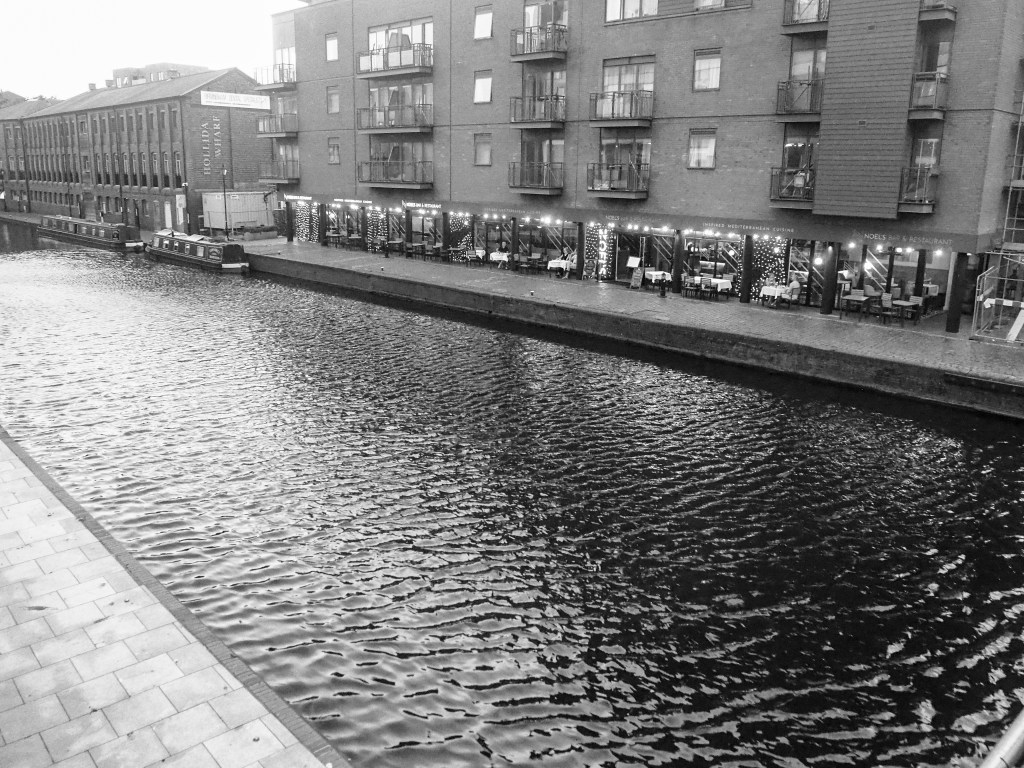
Early Scottish and British canals were dug by hand and opeated with a lock system that was cranked by hand or draft animal. It was a daunting task but most canals are only about waist deep and the boats are shallow, long and narrow. Even today the boats don’t move fast, about four miles per hour. It is easy for many people to walk along the path while a partner navigates the boat along the water way.
Like any new technology the canal building boom resulted in a bust. I’ll save the story of that for another day.
Overcoming the elevation of the land is a critical aspect in building and operating a canal. At its cheapest and most simple operational practibility, the boat goes into a section that is like a container with removable ends. One end of the container is closed and the canal water fills in the space to its own level. To raise the boat the back of the container is closed. Once enclosed, water is added . As the water fills the container it lifts the boat. Seems like a miracle but its really just physics. Sometimes multiple locks are placed back-to-back if the rise requires a higher lift. It takes time, especially if no pumps are involved and the water is left to fill in the area on its own.
If all of this is confusing as you read it, here is a video explaining how a lock works: https://www.youtube.com/watch?v=5JnFo89iZvg. Even though it is contemporary, the video takes us back in time as it shows us how the locks worked without any external energy (like an internal combustion engine gas or electric powered machine). If you’d like to get lost in the YouTube hole here is a contemporary coal narrow boat working with its two man crew: https://www.youtube.com/watch?v=w0D65ixXDzo.
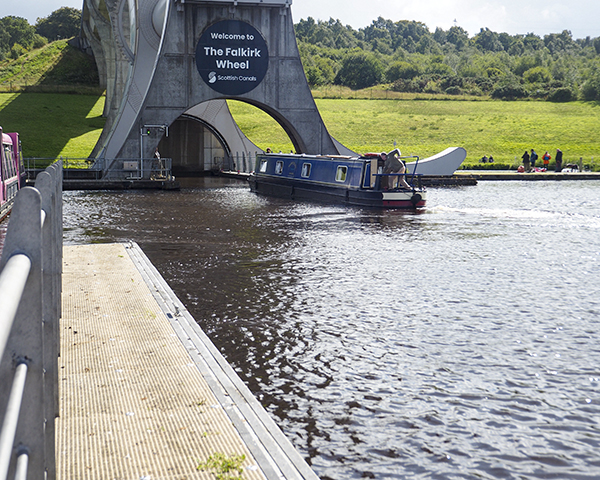
The advent of electricity combined with bigger and stronger machines have made it possible to upgrad a canal to a newer lock system. Using electric power to lift and swing a boat and the water surrounding it in a small space where there previously were multiple locks. Such is the case for the Falkirk Wheel, a technical marvel less than twenty years old.
The Falkirk Wheel is like a double sided pendulum. Using the weight of a boat and the water necessary to float it on one side reduces the amout of power required to lift the boat on the other side and reduces wear and tear on the machinery lifting the boat. If you’ve ever seen an incline railway where the two cars pass each other in the middle of the track and balance each other out going up and down, you’ll have a working idea how the Wheel works.

The Falkirk Wheel replaced a series of twelve locks from the original canal system. The British Waterways Board sought solutions to bridge the Forth and Clyde Canals which were no longer linked. A contest challenging modern engineers to find a new solution to the old problem of raising and lowering the boats along the canal was completed by a team of British Waterways Board and engineering consultants Arup, Butterley Engineersin and RMJM. The Wikipedia page has more specific details if you’re interested. I came upon the Falkirk Wheel on a tour. Because of the time required to load everyone on the tour bus and the timing of the excursion, I didn’t have the opportunity to film a video of the process. The photos here are taken from the dock and inside the canal boat we sat in while the contraption lifted us and then returned us to our origial starting place. Here is a video showing the “lock” in action: https://www.youtube.com/watch?v=BBv23t5GsJU
I have to confess I feel the pull from these old canals and their old and updated technology. I’m not sure its worth another airplane flight in crampted quarters and all that goes with it…but I’m tempted. A vacation living on a narrow boat that explored the off beaten pathways, getting to know people who are full time narrow boat residents, and mixing a little physical labor with the relaxing atmosphere looks pretty good. Of course, there are the photo opportunites along the way too.


 Talkin' about the past, photographing the present