We arrived at Hornitos, California late in the day close to the golden hour. The golden hour, actually two hours before sunset, makes colors deeper and reduces the contrast between the light sky and shadows. Shadows are our friend when it comes to communicating three dimensions on the flat plane of a photograph, so our arrival time was perfect.
 Hornitos is Spanish for “little ovens” named after the above ground graves from early gold prospectors in the Gold Rush days. Today the old town is little more than a couple of buildings on a small secondary road.
I limited my creative tools to a DSLR, fast lens, the golden hour, and my intuition and training. My objective: to make art and not documentary photos. By art I mean photos that evoke feeling and a sense of wondering. I have in mind to be purposeful in composition, use aperture to control the depth of field and take advantage of shadows.
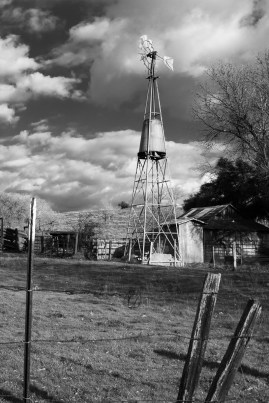
Among the potential subjects was an Aermotor windmill, an essential farm tool in the pre-electric era. In the early 20th Century Aermotor came to dominate the market, so much so that the odds are good any old windmill you see going down the highway is an Aermotor. These self-oiling water pumps use the motion of the blade to work a suction pump. Water storage is always close by, often on a platform, so gravity does the work of everyday water pressure on the farm. Placement of the tower and blades to the water storage tank varies depending on the need of the farm. I’ve never seen an integration of storage and tower like the one pictured. Look closely and you’ll see the storage tank custom sized to fit inside the tower. The maker solved the space and gravity problems in one fell swoop. All of life is a compromise so he sacrificed a large tank for the convenience of locating the tub within the frame. How ingenious! I liked the position of this windmill and tower to the house and took photos from a couple of angles before settling on the one you see.
Three things make this picture work. A large depth of field, f8, careful framing to include something in the front, middle and back of the image, and the choice to use black and white. Let’s look at each of these to see why they work for this image.
On a digital camera the sweet spot of the lens is f8. Overall this aperture creates good depth of field, the lens is at its sharpest, and chromatic aberration is not an issue like it can be at f16. (If I had been using a larger format, medium or large format film camera, I would have used f16 for all of the same reasons.) F8 makes the picture sharp from front to back.
Next, I included the fence posts in the front of the image to draw the viewer into the image and focus on the subject-the windmill. I took several photos including one without the fence. While, I knew this composition would work for the idea I had in mind, I also knew I wasn’t coming back, and another composition might work for another day and purpose. It’s good do “work” a scene to get as much out of it as possible. Who knows, on another day I might prefer the no-fence version. The other aspect of the framing was my desire to include the clouds.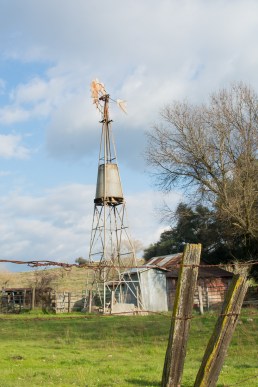
I have pictures in my mind of the Dustbowl and with the help of historical research and the novel and movie Grapes of Wrath I think of the 1930’s when I see an old windmill. Part of the nostalgia of these images is the medium: black and white photos. Between the black and white conversion and the clouds I wanted to evoke the feeling of those old dustbowl days and with it the heartiness of Americans and the American spirit.
I’ve included both the color and black and white versions of the image. Let me know what you think.

 Talkin' about the past, photographing the present