
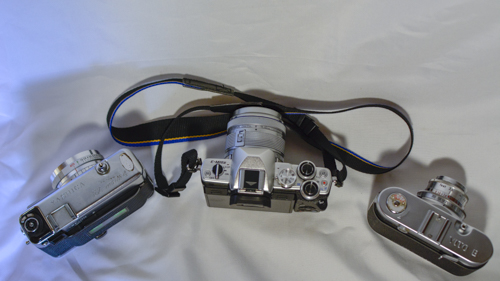
It was the best of machines; it was the worst of machines. With apologies to Charles Dickens, this week I’m looking at three cameras that look nearly identical. It seems there may be an ideal size camera.
There are two distinct parts of the camera market. The first is the professional and serious amateur. Those who either make their living from taking photos or enrich their lives by throwing themselves deeply into a hobby or selling/distributing photos to friends and at street fairs. The broader market is the entry level photographer. The camera that best meets his or her needs is a point and shoot camera. The point and shoot camera has little or no learning curve and is high enough quality that on occasion it allows the owner to get a wall-worthy photograph. The target market for this consumer crosses gender and age lines. It makes sense that this magic camera must be a certain size and have certain features.
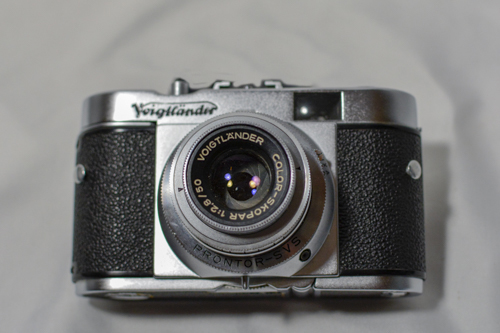
We’ll start with one of my favorites-the Voightlander Vito BII. I’ve written about this camera in the past. I think it might be one of the best street photography cameras ever produced. It takes 35mm film and the photographer gets shutter and aperture control, both directly on the lens. It fits in the hand comfortably and is made of metal. With a metal body it feels substantial enough to take seriously and is sturdy enough to be dropped and still work. The major off-putting aspect of this camera is the focus. It is a viewfinder camera. This can be concerning for many shutterbugs today because we are so used to being able to focus precisely. Regardless of whether you are used to auto focus or have experience with an old SLR with the split prism, we like being able to see our focus is spot on.
A viewfinder camera only has a sight glass. Good focus relies on your being in the right range, say 6-8 feet away and the depth of field allowed by the aperture (f number) of the lens. The Vito BII helps the photographer in this regard by having two nearly automatic marks on the lens. One in medium range, about that 8-foot away distance, and an infinity. This works so well that I frequently use one of the two settings and forget about the rest. In fact, I usually use the Sunny 16 rule with this camera, put the focus at one of the two spots on the lens and just shoot. This camera makes prints so crisp and sharp I don’t think most people would be able to distinguish them from a digital photograph.

The second camera is the Yahsica EZ-Matic 4. It uses 35m film also but this one has a twist. In the late 1960’s and into the early 70’s camera companies moved to a cartridge-based film loading system. Called 126 film, it was the same size as 35mm but instead of having the canister the film is preloaded into a cassette. Drop in the film cassette, advance the film to number 1 in the window and shoot away. You may know this group of cameras by the name Kodak gave them, Instamatic cameras. The Yahsica EZ-Matic 4 is perhaps the top of the heap in this category.
It has a metal body, a focus ring, aperture control, including an auto feature. The lens is surrounded by a light meter eliminating the Sunny 16 guess from the past. The Yahsica 38mm 1/9 glass lens is very sharp. As you can see in the photo, it is about the same size as the Voightlander. Drop in the cassette, advance the film, focus (it is also a viewfinder) and click the shutter. To help in your focusing the viewfinder has four images on the right side, a head only silhouette, a half body silhouette, a group silhouette, and a mountain to help you focus. A needle moves through the images to help as you turn the focus ring. It is, as its name implies, EZ. The 4 references the old four-sided cube flash that was popular in its day.
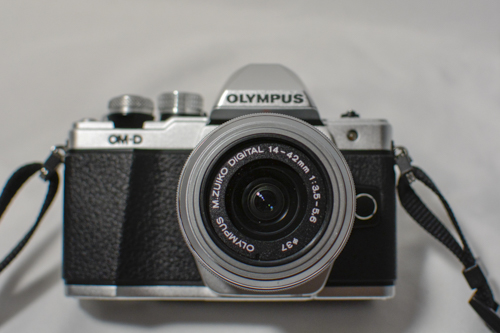
Lastly, we come to the new Olympus OMD-E-M10. A new digital camera designed for the same market. It can operate in fully automatic mode or in shutter, aperture, or manual mode. There are a couple of things that separate this camera from the other two besides it being a digital and not film camera. First, it takes interchangeable lenses like an SLR. The lens in the kit is a 14-42mm zoom lens, but the family of lenses is broad enough for most people.
Second, it has auto focus. There is no guessing about how to get a sharp photo with this camera. Your only challenge will be to make sure it focuses on the part of the frame your eye is focusing on. It also has a big touch screen LED color display for those who are used to using a phone as their primary camera Lastly, this camera will shoot video. If I don’t want to specifically shoot film and I’m heading anyplace where a big DSLR is too obvious or takes up too much space, this is my go-to camera. It probably gets more use than any other single camera in my collection.

So, what’s the bottom line? Each of these cameras are about the same size, 5” x 3” x 2-3” wide. I’m not so crazy about the Yashica. It looks fabulous. For display purposes sitting on the shelf it looks like a good quality 35mm camera from back in the day. Of course, it is. But I don’t like the 126 cartridge. I’ve rerolled 35mm film into the cartridge but with different sprocket holes and limited to only 12 frames, it just doesn’t’ speak to me.
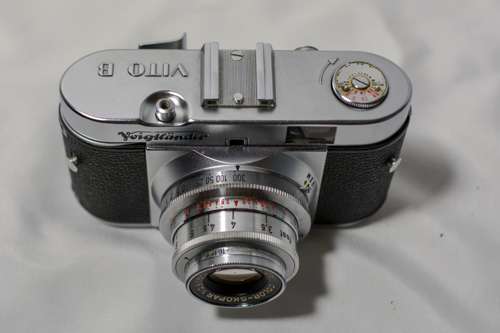
The Voightlander is a wonderful camera. I enjoy using it and consequently it almost always has a roll of film waiting for me. The lens is coated so the color photos are as good as black and white. I have a Canon AE-1 Program, but the Vito B gets more use.

The Olympus OM-D gets more use every week. I bought it for the activities and hobbies I do. I wanted a smaller camera that I could easily pack in the motorcycle and toss in a dry bag in my kayak. For the same reasons, small and light weight, it works for the day hikes and camping I do throughout the year also. I’ve added two additional lenses, a 25mm prime and 150-300mm telephoto. I can’t imagine I will expand it beyond these three. Lately I’ve also begun using it for some video. The combination of size, weight, and flexibility make it easy to grab. That is not to say it replaces my Nikon D7100, a truly professional camera that I use in the studio and for professional gigs.
So, what’s the payoff here? One of the biggest disadvantages of a digital camera is that you pay for all the film, developing and service of the camera right up front. If you are an occasional shooter you may be throwing too much money at nearly any digital camera, especially in the digital phone-camera age. With the price of film cameras being so low, you have to shoot and develop a lot of film to match the cost of a quality point and shoot camera. Developing easily incudes digital images today, and film doesn’t change the OS it needs to be seen and it doesn’t get hacked, stolen, or dropped in the water. On the other hand, you will never immediately post to any social media platform with a film camera, and video isn’t possible.

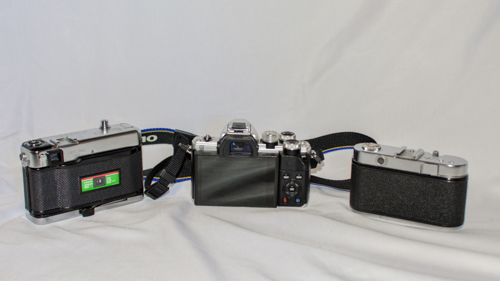
For my part, I prefer to have several cameras to choose from and I enjoy developing and scanning film at home.
What do you think? Is there a perfect size camera?
 Talkin' about the past, photographing the present