
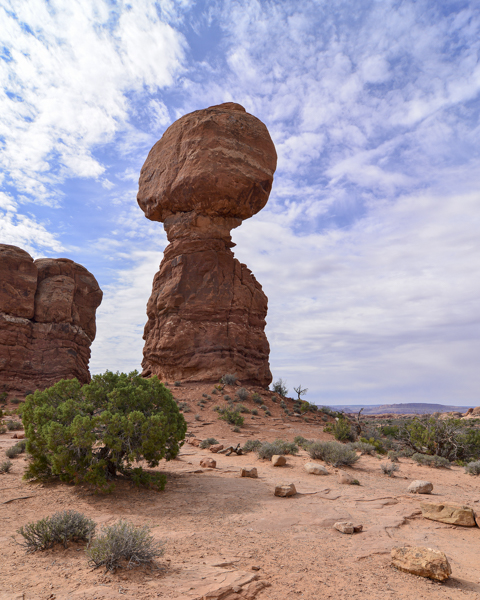
Here in the city, it’s raining. Limited breaks between storms are counted only in hours. The rain has fallen for over a week. Unable to go outside for any length of time, I’m left with dreaming about where I’d rather be. Today I’m focused on Arches National Park in Utah. I visited Arches in the fall of 2021, after families were imprisoned by the school schedule. Not far from the visitor’s center is Balancing Rock, a formation that looks a little like a bowling ball set on top of a pillar.
Balancing Rock isn’t really balancing, the column is being weathered away in a familiar pattern. I wonder at what point, or perhaps when the area being worn away to a point, will result in the top of the column really balancing. I wonder how long it will take. Looking at it from different angles it takes on different forms. From one side it looks like a balancing basketball or bowling ball. I guess this is how it got its name.

From another angle the oblong “head” reminds me of the back side of the statues on Easter Island. Those statues are not only unique for their size They are unique because to their location, poised on top of a bluff overlooking the Pacific Ocean. A popular tale is when the Easter Island people were asked how the gods ended up on the cliffs their response was “they walked.” Westerners didn’t believe them and chalked up the answer to a lack of understanding on the part of the native people. But the Europeans didn’t have an answer. The explanation seemed impossible, and they rejected the idea it was aliens from the distant past. (Sorry to burst the bubble of all you Stargate fans.) Nova did a great show called “The Secrets of Easter Island” (2012) that sought the answer to the question. The show documents how the statues were moved from a quarry miles away to their final location. I’ll cut to the chase, they walked. It’s funny how decaying rocks thousands of miles away in Arches can trigger memories from something unrelated. These rocks weren’t moved by man.
As a speck of a person in the landscape and in history, these natural wonders make me humble.
There is something magical about the red sands of the Southwest. While not barren, the area is bleak with limited vegetation and few trees. The compressed sand that makes up the hills and eventually the arches is being weathered away by rain and wind making a carpet of red sand that isn’t at all like a beach, making the sandy landscape both familiar and foreign at the same time. Compression of the sands from an ancient sea made mineral bands which create beauty in both colors and wrinkles. Those wrinkles, like an old man’s face, have stories to tell, and like the old man, most of those stories from the past remain unspoken.
And so, we get to wonder and make it up, like the kid’s game of finding something familiar in the clouds, or the Greeks finding their gods and heroes in the heavens.
The same wind that cuts away at the sandstone leaves us with this natural sculpture garden. The wind also brings in clouds and the rain that results in the only major river in the region, the Colorado. The clouds give texture to my photos and remind me of the thunderstorms that threaten flashfloods as they approach Arches National Park from hundreds of miles away.
The scale of everything near Moab, Utah is large. Reducing the forms and features to anything printed on paper or electronic pages seems like limiting the power of gravity. Like Yosemite, Arches puts me in my place. As a speck of a person in the landscape and in history, these natural wonders make me humble. I’m content to observe and wonder.

What about you? What do you see in Balancing Rock? Something supernatural? Something comical? I’d love to hear about it in the comments.

 Talkin' about the past, photographing the present