We were kissed by the dew. Each morning as we walked through fields of green grass we were greeted with damp but never wet ground cover. Never overly wet and barely enough to stay on the hem, by the time we had an honest start to the day it was gone. I guess we didn’t give the dew a chance since our starting time was 9am or later. It was an easy way to start the day.

Armed with our Full English Breakfast, we began each day with directions in hand and anticipation in our hearts. Our intention was to walk every day over ancient pathways, so you could say we signed up for a challenge .
Here is an example of the directions:
1.20 km – BEAR RIGHT at the end of the field, ignoring the sharp right, and following the hedgerow on your right-hand side
1.40 km – Continue STRAIGHT ON through the wooden gate, follow hedgerow to your right
1.70 km – STRAIGHT ON ignoring left turn
2.0 km – At end of the field, BEAR LEFT then TURN RIGHT through a metal gate, follow hedgerow to your left
2.20 km – STRAIGHT ON through a wooden gate, diagonally through a field passing a wooden stump with a way marker on it
2.50 km – Pass through the wooden gate and BEAR RIGHT staying on the path, following the hedgerow
2.60 km – BEAR LEFT across the field, once the field has been crossed, BEAR RIGHT keeping hedge to your left
2.90 km – Cross the bridge out of the field, TURN LEFT into next field then BEAR LEFT following the low fence to your left
It is unlikely that the in-the-field confusion is apparent in the directions. Here are a few things that are not obvious from your computer screen. At 1.40km our directions instructed us to go through a wooden gate. It turned out there are many types of gates. This was part of the fun and some frustration. Here are a few photos of the items that qualified as a gate: a foot gate with a hasp, a climb-over-the-rail gate, and a cattle or vehicle gate. Over the course of the week the types of gates became more obvious as we learned what to look for. At a couple of intersections, however, there was more than one type of gate or there was a gate in the middle of the hedgerow that seemed to fit the directions, maybe.


(Note the old Norman church in the background.)
You may have had this issue following directions to a friends house where the directions read “bear left.” What is the difference between turn left and bear left? Does it look the same each time? Look at this section at 2.20km, “through a field passing a wooden stump with a marker on it.” I thought I had learned this lesson years ago. Reading this I was transported back to my days delivering furniture for Mayflower Van Lines in the central and remote parts of California. Us city slickers like addresses and intersections, even road numbers are familiar to us, but these aren’t the rules in the country. Two distinctive “rules” come into play in the country. First are landmarks, as in “turn left at John’s BBQ.” Second are old landmarks that no longer exist. They are a type of code for the locals. The code is sometimes used to confuse the city slickers and other times the code has no malice intended. Sometime in the past a neighbor or perhaps a farmer took down a diseased or majestic tree. Everyone had an opinion about it but for some reason it had to go. Farmer Smith’s tree is long gone but everyone in the community knows what and where it was. It is an obvious place to make a turn or continue straight for those in the know. These directions might look like, “when you see Farmer Smith’s old tree stump continue for another 500 feet and make a left onto the road.” The events or buildings still exist to the residents. I’m sure you have a similar situation around your neighborhood. These directions more closely resemble the “wooden stump” description above. Perhaps I hadn’t learned it as well as I thought.


In an area that has been continuously inhabited for over 1,000 years these directions probably look fine to both the writer and reviewer. Everyone knows about that tree stump like everyone knows what a gate looks like. But beware to the traveler! One stump looks like another and the difference between a dirt road and a paved one is obvious. Why the writers couldn’t be more specific escapes us and our city minded brain.
So every morning we set off with our directions in hand confident that this set would be more specific than the last set. Take a look at this peaceful walk in a path through the woods. With temperatures in the high 60’s to low 70’s walking along rolling hills, at casual pace, and in anticipation of a small village ahead of us just waiting to prepare a coffee or lunch, every day was poised to be a new adventure. Our daily learning curve helped us and we only walked off the route a couple of times.
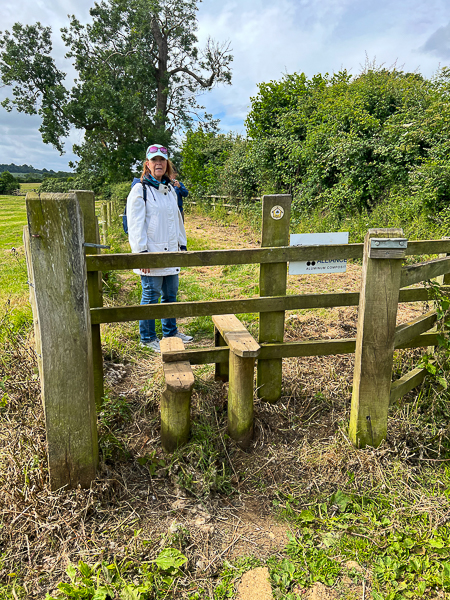
Taken from Shelia’s iPhone 13
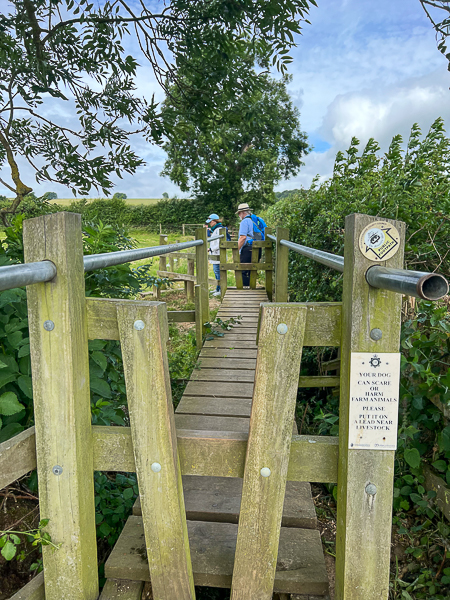
Taken from Shelia’s iPhone 13
Back on the main path again and more than a little confused, we were passed by a couple we had seen before. Trading pleasantries we asked for some clarification as to our location and the directions that may as well have been in French. Assured we were back on the right path, we continued on our way. By this time it was approaching lunch and we eagerly anticipated walking through the next village and finding a local pub. Who would think the directions would lead us along the side of the village instead of through it so we could stop for lunch? When we greeted the same couple a couple of hours later we found out that we had completely missed the village. They were happy to tell us about their experience. It turned out they were doing a pub crawl on their day off and had stopped for another pint.
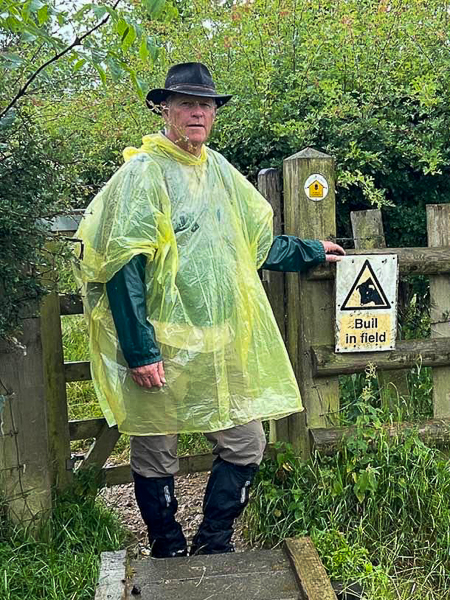
Taken from Shelia’s iPhone 13
We added an extra mile on the walk that day, and an early dinner.
There were wonderful things to see on our walks. Most of the old growth forest was long gone in the area, in part to build those marvelous wooden ships during the golden age of sail. There were still plenty of large, old trees to provide shade and pleasant scenery along the way.


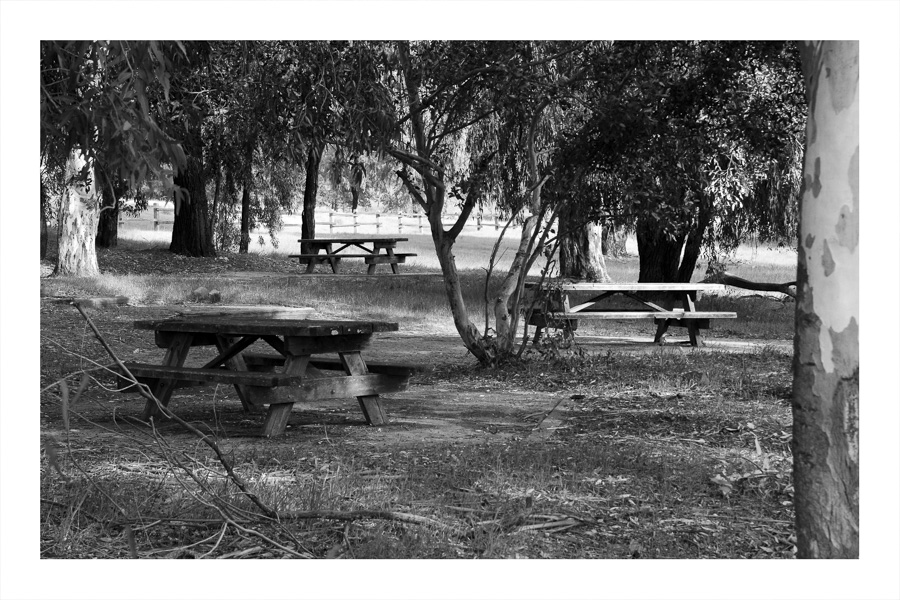
 Talkin' about the past, photographing the present