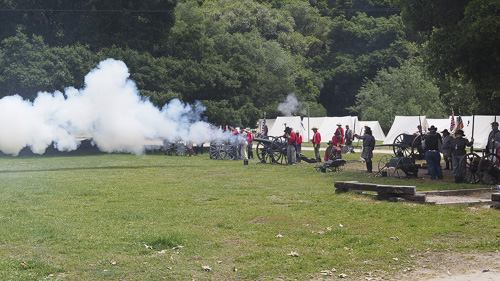
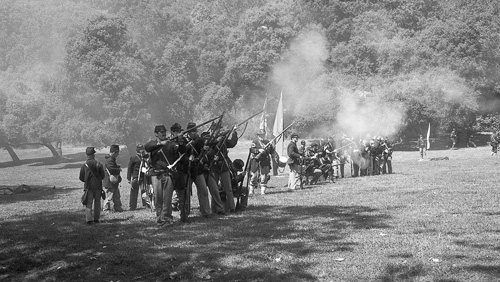
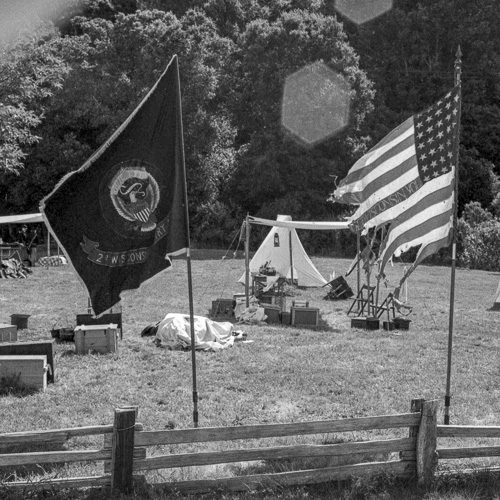
When I lived in San Jose, a local venue held an annual Civil War Reenactment on Memorial Day. In addition to providing an opportunity to ride the steam train, families had a chance to view a mock battle between the blue and the grey. The participants of the event dress in mostly period- correct clothing and went out of their way to purchase other props for the event. These included pots and pans, firearms and other weapons, and other accouterments to round out their costume and experience. In addition to dressing the part, participants immersed themselves in the culture and attitudes from their respective regions, either North or South but sometimes even to the state their militia was recruited from and, on rare occasion, focusing on a specific person.
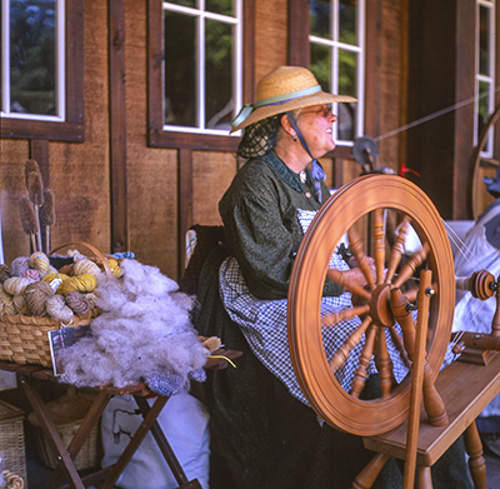
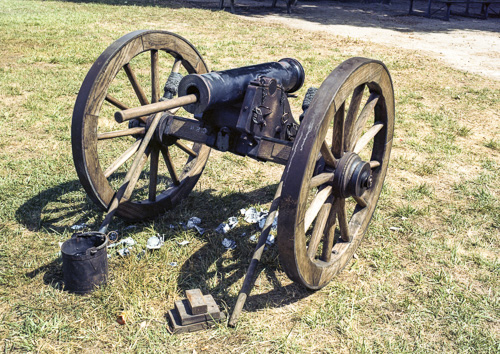
Big booms and belching smoke from the black powder artillery and small arms made for a great scene. Dads and kids were impressed by the spectacle, dogs cowered and became skittish, and some of the ladies decided there must be a better way to spend a day. The regalia of the day was very impressive. Participants camped out for the weekend. They cooked their own food over an open fire, polished their firearms, and participated in skirmishes at appointed times throughout the weekend. There was a bit of a script to the show (certain actors are fated to die on the field of battle). The whole experience appeared authentic.
Their authenticity started to wane, however, when I walked into various camps and began talking with the participants about the event, their equipment, and the role they played in the weekend’s activities. I know only a little about firearms of the period. Anyone with an interest who has taken the time to study and collect the various small arms used in the conflict can easily impress me and send me searching on the internet for confirmation of some truly horrific guns or items put into guns and artillery to massacre their opponent. The same is not true about the causes of the war. The actions of governments on both sides including the Confederate Constitution, the actions taken preceding the succession of South Carolina, the attitude of President Lincoln when the war started, and his change as the war progressed that resulted in the Emancipation Proclamation and 13th Amendment is an area I have studied.
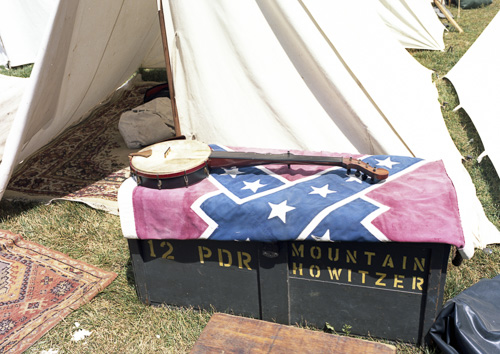
In discussing the reasons for the conflict with the actors/participants representing the Confederacy I frequently heard “We’re fighting for our heritage”; I heard more than once. What does that mean?The representatives of the CSA in 1861 were clear what they meant when they drafted their Constitution. It meant the right to hold slaves in perpetuity. It meant those slaves would be black. They would never be given rights as men (people if you will) or any say in the current or future government of the new country. Here are the words directly from the Confederate Constitution Article IV Section 3:
(3) The Confederate States may acquire new territory; and Congress shall have power to legislate and provide governments for the inhabitants of all territory belonging to the Confederate States, lying without the limits of the several Sates; and may permit them, at such times, and in such manner as it may by law provide, to form States to be admitted into the Confederacy. In all such territory the institution of negro slavery, as it now exists in the Confederate States, shall be recognized and protected by Congress and by the Territorial government; and the inhabitants of the several Confederate States and Territories shall have the right to take to such Territory any slaves lawfully held by them in any of the States or Territories of the Confederate States.
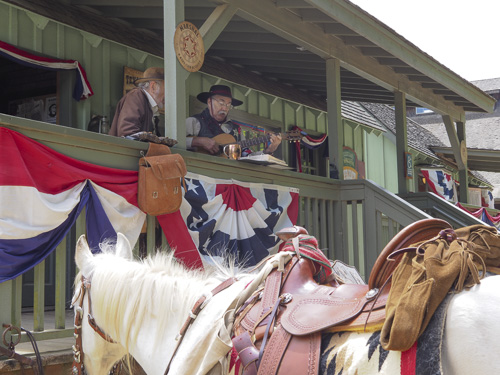
In response to the statement, I had to ask, “what about the slaves?” The Old South, Jim Crow, and a century of oppression against the former slaves and their offspring had prepared the participants of the event for an answer to my question. Answers varied from “Its good for them, they got free room and board” to “they learned skills” and sometimes “it wasn’t that bad.” Occasionally I would hear “they should stay in their place.” Others felt embarrassed, uncomfortable with my question.
The embarrassed group generally fell into two categories: anger-how dare I ask this question, or ignorance-this is the 21st century we don’t do slavery anymore and so I haven’t wrestled with it. The overall attitude from this group of participants was “I’m not a racist, I’m honoring those who fought and lost the war and a way of life.”
They put themselves in a tough position. Today, if you agree with the Declaration of Independence ,“all men are created equal, that they are endowed by their Creator with certain inalienable rights, that among these are Life, Liberty, and the pursuit of happiness”, representing the Confederate states is problematic. Are Civil War reenactments just a game, a chance to relive history and expose the public to costumes and living experiences from the past? Maybe the whole thing is innocent. But events and consequences of actions taken in the past have real world repercussions for us. This is especially true with America’s original sin, slavery.
Just because the Confederates lost the war on the battlefield, it didn’t mean their attitudes about slavery and the status of former slaves who were suddenly free citizens had changed. They could use legislation and sabotage to turn back the gains made while they were away in their succession attempt. They had successfully used their political power before the war. Southern states had gained extra power because five slaves were counted as three free men for representation in Congress. South Carolina and the states that followed her into rebellion used that power to maintain slavery in the antebellum period before the war. After the war Congress understood each emancipated slave now counted as a single person thereby increasing the representation of the former Confederate states. Congress was aware of the bullying power of the South in the antebellum period that demanded the legitimacy of slavery and the right for it to be upheld even in non-slave states. Without the successful efforts of the Union Army, the Dred Scott decision (slave owners had a right to keep their “property” in free states) and the Kansas-Nebraska Act (citizens would determine if a new state would be free or slave) would remain in effect. President Lincoln and the members of Congress who stayed loyal to the Union understood the importance of law in a country founded on laws. Would the newly reinstated states seek to turn back emancipation and suffrage for former slaves by legislation? Of course, they would! And they did.
How did Congress deal with this threat? They blocked former insurrectionists from running or holding public office. Section 3 of the 14th Amendment is all about this. Without Section 3 all those Union soldiers died in vain. How do we know? After the war every state of the former Confederacy passed Jim Crow laws to legally limit the rights of black citizens. While the US Constitution under the 13th and 14th Amendments guaranteed their citizenship, the Confederate states were able to limit voting, holding elected office, limit the school children could attend, restrict restaurants and hotels Blacks could visit, and even which public restroom could be used. We can say with certainty the restored representatives from the Confederate states used their power to regain their pre-war status.
Should Section 3 of the 14th Amendment still apply? Will the citizenry of the US allow the rejected ideas of the Confederate States to become law and practice? If we do, we fought the Civil War in vain.
Civil War reenactments are one way we can remember the past and the sacrifices previous generations made for todays diverse American society. An outside play or drama can transport us to another era. We must be careful not to transport our own worst angels along with it.


 Talkin' about the past, photographing the present