
It’s January and it’s raining. I wouldn’t be surprised if the sun is out in Death Valley. I’m sure it isn’t 100 degrees due to its average high winter temperatures ranging between 67 and 73 degrees in January and February with lows of 40 and 46 degrees Fahrenheit. While it isn’t a metropolis and you can’t stay at the Hilton or get your favorite sugared up latte or Frappuccino, there’s so much to see and do outside.
People visit for a variety of reasons. Spending time outside in the dry desert, experiencing the unique smell of the air, and a view across the clear valley are high on the list of reasons and lead to a relaxing visit. My interests as a photographer lead to both natural and man-made scenes. On the natural side I‘m focused on images in two general categories, nature scenes and abstract images. Let’s begin with clean wind-swept sand dunes.
On this trip we drove in through the Panamint range and entered the national park via highway 190, passing Stovepipe Wells and stopping at Mesquite Canyon and Dunes. We arrived on a workday in the early afternoon. We were greeted by dunes speckled with footstep divots left by visitors who had ascended the dunes for the areas unique look. Small mesquite bushes and relatively hard pack sand lead from the parking area to the dunes and many families took the opportunity for a little play time. You might like to do the same. You’ll find it has been a long time since anyone was out of the car if you take my route in. It was great fun to play in but to get the classic wind-swept dunes I needed all those footprints gone.
We had dinner at the Stovepipe Wells restaurant that first evening and while having a conversation with a couple who had ridden in on a rented Honda Goldwing the lights suddenly went out. With the silence and shock of the moment we heard the wind and rain descend upon the area and decided to call it a night. In the morning greeted us with by a wonderful windswept scene devoid of footprints, smooth and clean.
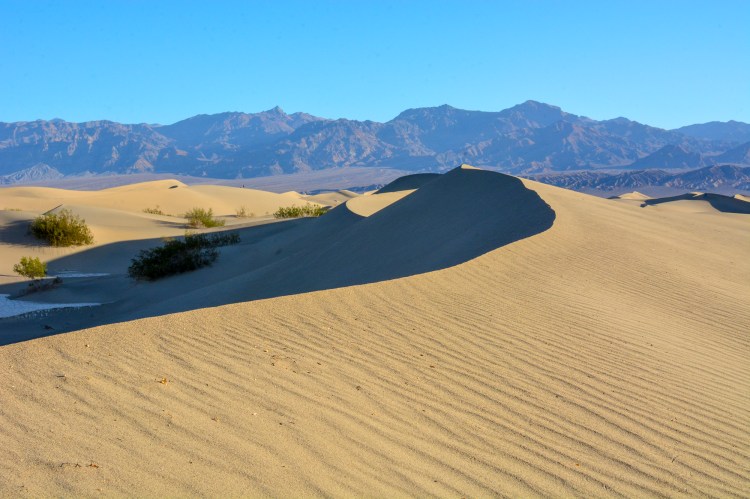
Death Valley (Mesquite) Dunes
One of the beauties of dune landscape are the lines created by the peaks. Either separately or together, the lines form intrigue and wonder. Shadows from a low sun highlight the lines. Early morning, before anyone has walked on the dunes is an ideal time for photographs. I welcomed the dawn at about 40 degrees and mostly in the dark. The previous day when I visited all the footprints, I had scouted out which dunes I wanted to focus on and what angle I would pursue. Of course, I was not alone in my quest for a quality photograph I could add to my portfolio and my wall.
I found this fellow photographer looking for his ideal spot. With a tripod and camera bag, a good pair of boots, and a good jacket he was searching for a location suitable for his wall also. What I like about this photo is the story and wonder of it. Is he looking for or returning from his photo? The idea of being alone in this dry, parched landscape is the stuff of legends that earned this area its name. His solitude attracted me.
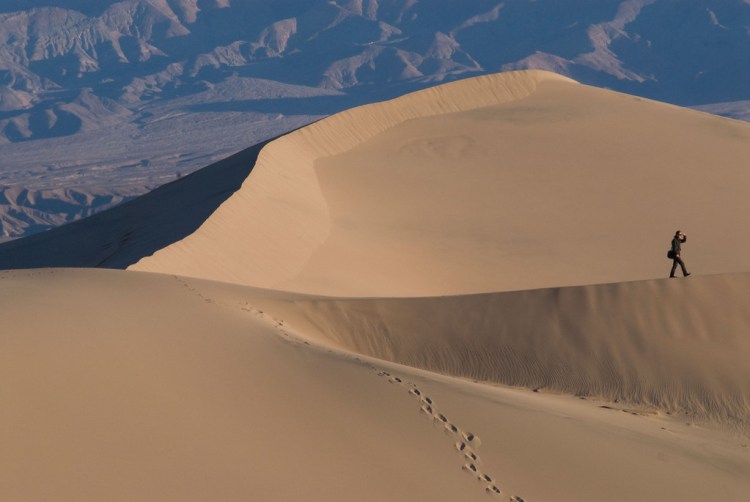
Taking the photo
If you follow this blog, you remember I am a fan of both film and digital images. (If you are not familiar, feel free to peruse past entries.) In the film days choosing the film was the first step to gaining a quality image. For color photographs, knowing the color cast of the film was critical. Kodak tended to be a warmer (think orange) film while Fuji had a cooler template (often referred to in the literature of the day as green.) The first decision was to choose the “right” color film. If you decided to shoot slide film, the two top contenders being Kodak Kodachrome (of Paul Simon fame) or Fuji Velvia in a speed of iso 50. Velvia was a favorite for landscape photographers due to its oversaturation of colors. (Some digital cameras simulate those old film emulsions, specifically Fuji cameras.)
For digital photographers, choosing the correct white balance setting will assure an accurate hue. Leaving the camera on automatic white balance risks an unnatural photo. The ends of the day, when the shadows make the dunes stand out, have different hues. Sunrise, referred to as the blue hour, is marked by a cool (blue) tint as the sun rises. The sunset is warmer (orange) which makes those afternoon photos so smooth and highlights beautiful skin tones. Choosing white balance of shade for the morning or sunny for the sunset helps the camera get the colors right, an important aspect for landscape photographers.
Your camera and the camera on your phone are set to automatically choose white balance. As with anything set to auto, sometimes the camera makes the wrong choice. If it chooses based on the cool shadow of the background in this photo it will choose shade with the consequence of a bluish tint to the photo. Your photo will not look like what you saw when you arose early in the morning to see and capture the smooth desert sand. If you pick sunny, the dunes will be the correct color while the blue tint of the mountains will remain. One step you can take to get the photos you really want is to make a purposeful choice about white balance. (I wrote about it here: https://davewaltersphotography.wordpress.com/page/10/).
There are other great landscapes in Death Valley. In the next post we’ll wander over to Artists Palette where I used a 1950’s 35mm viewfinder camera.
Have you been to Death Valley? What were your favorite spots? Did you get any especially memorable photos? Leave me a comment.
While you’re at it, why not subscribe? You’ll get an email reminder when I post a new article, so you won’t have to guess what I’ve been up to.

 Talkin' about the past, photographing the present