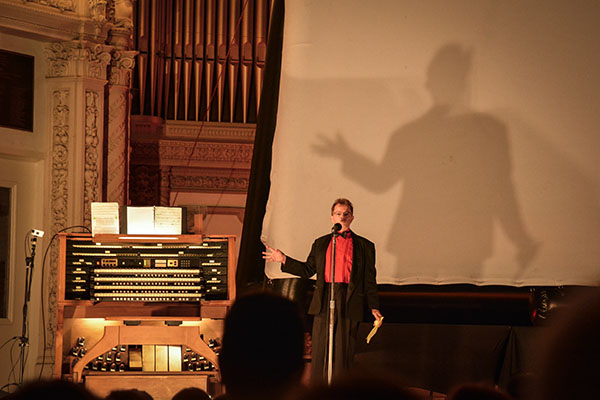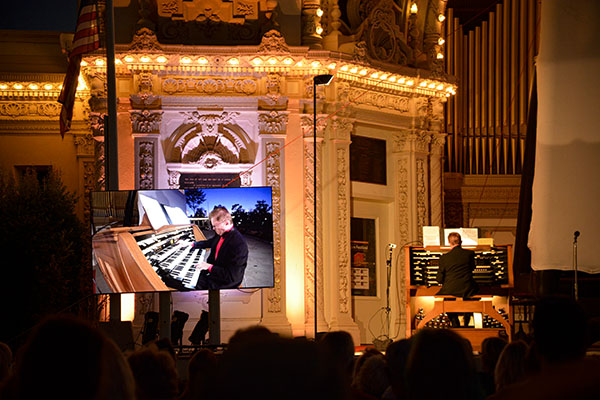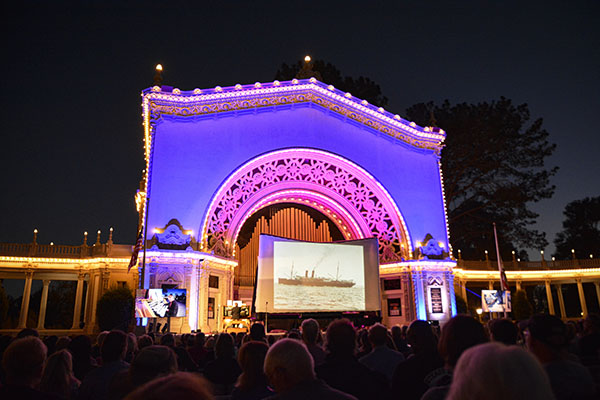
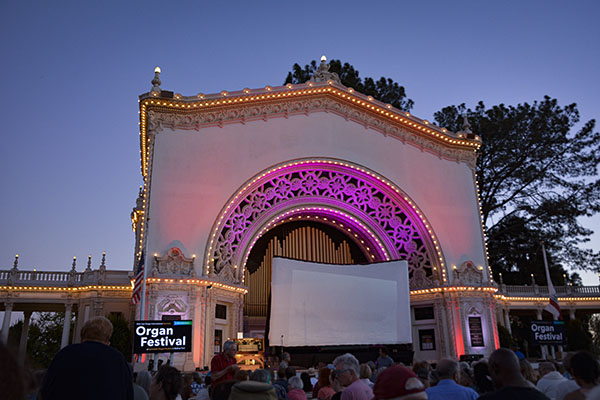
The silence is deafening, at least it is with a Buster Keaton movie from the 1920’s when it’s accompanied by the 81 rank Spreckels pipe organ at Balboa Park. Gifted to the city and the world by the sugar magnates and brothers John & Adolf Spreckels for the 1914 World’s Fair and part of the greater construction for the fair, the organ sounds as good as ever. Buster Keaton is as funny as ever too. His rubberman physical comidies and deadpan reaction to whatever situation he is thrown into doesn’t really need a lot of words. Both Keaton and the Silent’s have fallen out of favor for a long time. I don’t know if they will make a comeback for the public at large but I have casual evidence they could with the right exposure.
According to Dana Stevens’ recent biography of Keaton, Camera Man: Buster Keaton, the Dawn of Cinema, and the Invention of the Twentieth Century, he learned how to fly and fall without getting hurt in a vaudville act when he was a kid where his dad litterally threw him around the stage. He took that act and his flexibility right into the movies. Keaton’s style of comedy made him one of the top acts in the early days of film along with Harold Lloyd and he ever popular Charlie Chaplin. He made the transition into talkies but a series of events and studio priorities limited his career. Many Boomers might remember him in the series of beach films in the 60’s with his deadpan act helping foil a group of motorcycle bafoons. Speaking personally, I watched Beach Blanket Bingo and other silly movies for Annete Funacello. I didn’t even know who that old man was back in the day. Since them I have become a big fan of the old Silents, primarlily when accompanied by a pipe organ.
Seeking to set the overall tone and share my love of the antics in those one hundred year old films, I put on some Keaton and Lloyd while my class a few years ago while they were doing some seat work in the classroom. It was designed to be something in the background to keep them off their phones browsing whatever they wanted to and at the same time reinforce our subject, the Roaring 20’s. They awarded me beyond my expectations by stopping to watch the antics and laughing (real LOLs.) Take that all you caped crusaders!
Like old Silent Movies, a theatre pipe organ is long since out of pop culture. You could say it’s a juiced up traditional organ, armed with some unique sounds for the movies like trolly car bells, ah-ooga car horns and a variety of cymbols and percussion instruments add to the depth of an instrument that has been used for over five hundred years. The Spreckels organ is the world’s largest public outdoor musical instrument. With about 5,000 pipes the organ has no problem filling the air with classical and movie sounds, all without any electrical amplification. The organ is the secret to the Silent films.
I know you can find the old Silents on YouTube and at the Friends of the Library sale on DVD at your local public library. If you decide to do that you might come away interested but I think they come off a little flat. The sound tracks usually leave a lot to be desired. Back in the day, the local theater decided who to hire to accompany the film, sometimes a simple piano, sometimes a small combo. The whole thing was low budget until the big movie houses were built with the addition of a large pipe organ, frequently the Mighty Wurlitzer. Regardless of the instrument, the musician decided what and when to play. Relegated to the background, after all the movie was the star of the show, the musician had to play for the entire running of the film. He also had to fill in during intermission and be prepared to help out if the nitrate film started a fire, an ever present hazard of the early films. Depending on what music the organist had in his repertoire, the amount of time he had to practice something new and the recommendations that accompanied the movie, each movie had a unique score. The DVD version has a score some editor picked up when the movie rights were acquired. Maybe some research was done for the publication. As I said above, I think they fall flat. A live pipe organ enhances the experience.
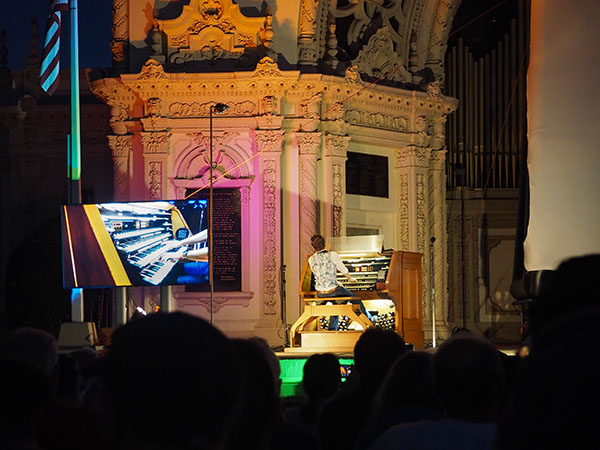
A pipe organ is essentually an orchestra. It has families of pipes to mimick the four major voices of the orchestra, strings, woodwinds, brass, and percussion. The brass doesn’t always sound brassy but the parts in the score designated for trumpets etc always follow the way the brass section’s parts ought to be (I know that sounds a little confusing.) The organist plays on a variety of key rows and has another keyboard at his feet, the he also plays. He voices the organ for each composition, programming the instruments with a series of stops. Every Silent organ accompaniest I have heard dug back into the past to find the sounds of the day, both popular and classical style scores from the decade. When we saw Lon Chaney’s original version of Phantom of the Opera, Dennis James, the accompanist felt obligated to play Andrew Lloyd Weber’s Phamtom theme when a masked Chaney arrived on the screen. It both updated the movie for us 21st century patrons and avoided to confussion from the audience who already knew his theme from the Broadway show.
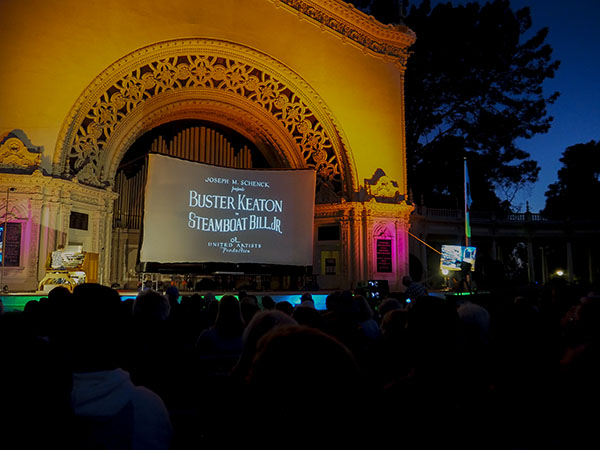
One last thing, because the Spreckels Organ is outside it has two additional things that make it unique. First is the instrument itself with the console lighted and the pipes partially alight. The second is the atmosphere of being outside in the summer, in San Diego (with the commercial planes coming over) with it’s wonderful temperate climate.
Here are few photos of our recent experience. If you’re visiting San Diego check the schedule for a free Sunday afternoon concert or a movie in the park.