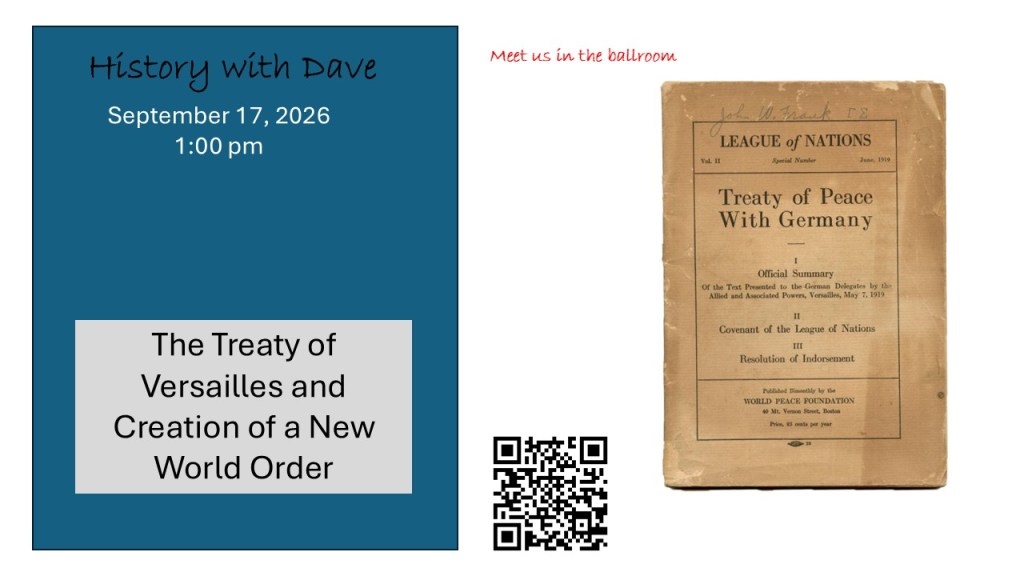
It seems to me we’re at one of those era-changing moments where the ultra-rich and oligarchs take back control of the government, economy and who knows what else. Of course I could be wrong, probably I am, but thinking about it gives me a chance to look back on the 20th century in a limited way. Today is part one of a series about the Treaty of Versailles. It seems to me the 20th century was an experiment in two areas: trying to make all nations play nice by agreeing and adhering to a set of international laws, and the rise of the middle class. Together they forced governments to pay attention to the wants of the vast number of people in the middle and shift in the economy toward consumerism. As Kai Ryssdal on Marketplace likes to say, “the consumer economy is the economy.”
Contrast this to the 19th century where the rich and propertied men made governing decisions and the wealthy controlled the economy-decided what to produce and what price to charge. In addition to economic expansion, it also resulted in the economy going through a series of crashes due to their poor betting choices and keeping their subsequent losses to themselves until a massive bankruptcy caused a depression (1873, 1907, 1929, 2008). I’m going to use the Treaty of Versailles and President Wilson’s Fourteen Points to walk through my ideas.
Let’s start by running through some of the major eras that preceded us. We’ll begin with the ancient empire era, the Roman Empire. At its zenith it controlled nearly all western Europe and the levant (Middle East) including Egypt. While early Rome was a republic with limited citizenry and voting rights, Emperor Augustus ruled the empire at his personal whim. There was a Senate but it’s best to think about it as an advisory body with selective individuals exerting influence depending on the charisma and power of specific individuals. The military acquired large areas of land that were incorporated into the empire. Conquered people were treated as vassals, subjects, or slaves of the emperor who demanded compliance with Roman law and customs. Under the Emperor and Senate’s guidance Rome built massive public works including roads (to get the army around) and aqueducts to move water. Most importantly, it established laws designed to be carried out, on behalf of its citizens, without prejudice. The Pax Romana lasted for over 1,000 years and brought a form of unity to Europe and the Middle East.
The fall of the Western Empire saw a change in government and finance to city-states. These independent city-states controlled the local economy and government. There were frequent wars between the powers to expand their influence. Each city-state was controlled by a group of oligarchs. While amazing engineering, art, and public works were created during this period, the oligarchs controlled it all.
Collapse of the Roman Empire and the limited reach of independent city-states led to the feudal era. I think of a feudal lord as the local bully or rich guy demanding you do things his way. He had the ability to make you do what he wanted so everyone agreed to play the game by his rules. Groups of these small-time leaders got together and made a common set of rules. Mostly, the rules were designed to keep them in power and everyone else in their place. They co-opted the Roman Catholic church to give them legitimacy resulting in an era with a religious flavor. No doubt much of the religious fervor of the day was genuine. By co-opting the Church, the power of the Pope grew. This system of feudal lords and a powerful church resulted in a repressive system and a series of religious wars known as the Crusades. For some scholars, the whole thing seemed a bit backward from the organization of the Roman Empire which resulted in the label “Dark Ages”.
Over the course of a couple of centuries the lords, through negotiation and brute strength, along with the help of the Pope, instituted an era where they could claim God (the Pope’s God) choose the kings and gave them his blessing. Under this system the kings claimed everything they did was right because God chose them. Meanwhile, the Pope was right there to speak on God’s behalf and in support of the kings. With God’s help the lords of the realm perpetuated this idea of the Divine Right of Kings to rule.
A group of thinkers and philosophers took a look at the system and saw the whole thing in a different light. With bastard kids everywhere in the houses of kings and queens and even some of the Popes (doesn’t seem to Christian, does it?), they started to consider whether or not this whole system was a scam. Using some of the ideas from the Reformation and the Ancient Greeks and Romans they reasoned the only way the kings stayed in power was because the peasants and lesser lords agreed to the whole system. They reasoned the power to govern doesn’t come from God but from the consent of the people being governed. Consequently, their consent can be withdrawn if it becomes too repressive or cruel. By observing the kings, they concluded if the same person or body made the laws, carried out the laws and then confirmed the laws are correct and just tyranny and corruption are the inevitable result. They proposed that each function of government should be carried out by different people who have the power to check the others in the case of wrong-doing or self-dealing.
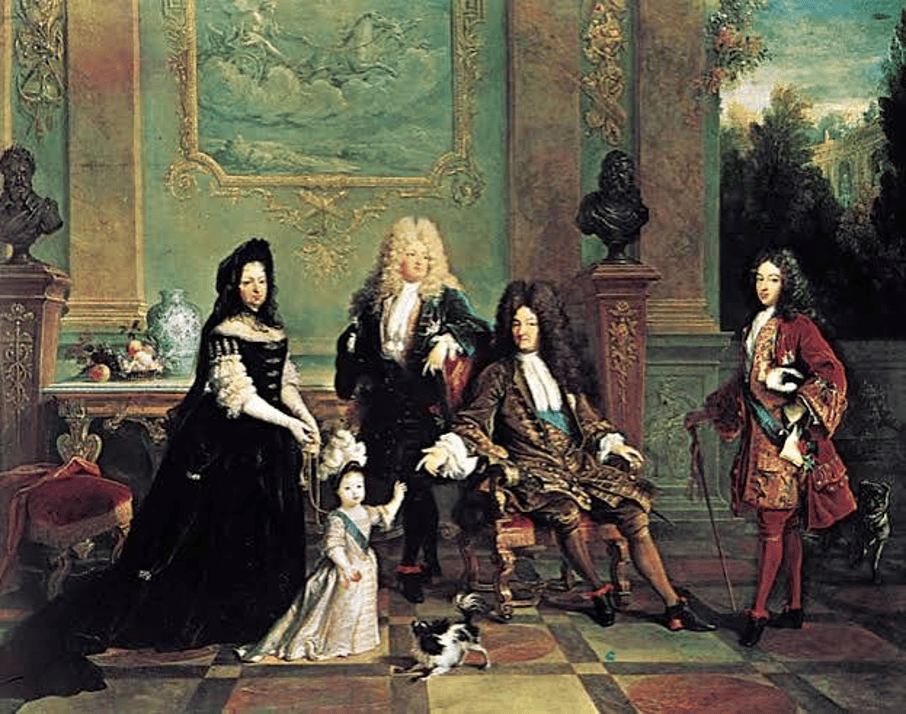
Just like that liberal democracy was born. From its first large scale adoption in the English colonies, it continued to spread throughout the 19th and 20th centuries.
That doesn’t mean it was all smooth sailing or that men of wealth and property just gave in. Money has always been a big influence on governance. The ability to write legislation in their favor, bribe officials who see politics as a means to wealth and power resulted in an era of bribery and corruption in the 19th century. Combined with machine politics, the bribery and corruption of the 19th century in the US led to the era of the “Robber Barons”. This abuse led to an attempt to correct the oppression of the era by a group called the Progressives.
The Progressive Era was the beginning of using the government to check the abuses of the rich, propertied, ruling class in favor of the citizenry. Specifically, it sought to thwart the bribery, corruption, double dealing, and machine politics that resulted in wage peonage and abuse of labor. Three presidents were associated with the Progressive era, Teodore Roosevelt, William Howard Taft, and Woodrow Wilson. The rise of the middle class during this time happened because of these reforms.
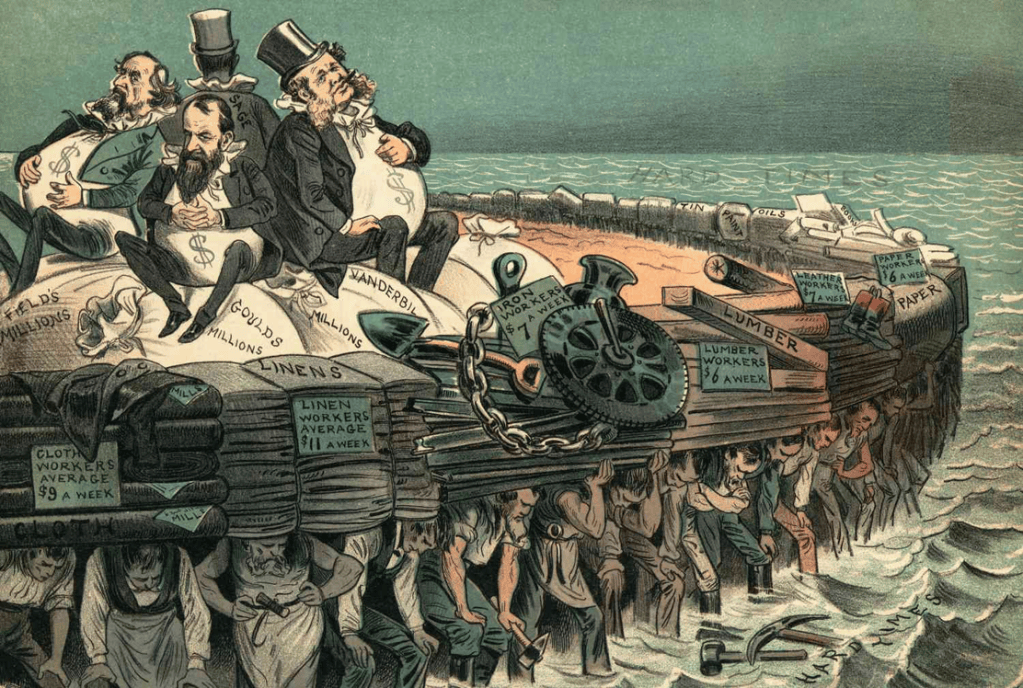
By using and passing laws to stop corporations from abusing workers and putting a strangle hold on specific parts of the economy, progressive presidents broke up monopolies, cleaned up corrupt government, and moved in the direction of worker’s rights. Each president on this list was increasingly more successful in limiting monopolistic power and helped ensure the rise of a middle class, one that wasn’t filthy rich or abjectly poor. This new class had the time and money to do as they wished, within reason.
With the growing middle class (8 hours for work, 8 hours for sleep, 8 hours for what we will) the economy began to shift toward consumerism.
Armed with growing success in applying law to all parts of society, and the tragedy of the Great War, President Woodrow Wilson sought to extend democracy and the ability to live meaningful lives to people in the old world. The old ways where unaccountable rich and privileged people made and enforced laws had resulted in history’s largest and most bloody conflict. He was convinced the “good ol’ boys club” had to go and the people of Europe were ready and willing to elect and run countries based on the consent of the governed. Secret treaties and backroom deals had resulted in the Great War; the establishment of international rules of law would prevent another world war.
Opening the conversation before the end of the war in a speech known as the Fourteen Points, he energized people from the crumbled empires of Austria-Hungary and the Ottomans. How important was the speech? The Germans contacted Wildon in October,1918 and asked him to arrange a general armistice based on his Fourteen Points.
Wilson was reacting to a set of treaties and deals the European powers had made in the years preceding the conflict. Each of the treaties and alliances were primarily defensive. Born out of centuries of conflict, each country felt they needed a friend in case of invasion by an unfriendly neighbor. Like many similar situations, deterrence was the first line of defense. Invading France might look different to the Germans if England and Russia joined in, for example. Second, if fighting actually began, those additional friends could contribute to victory.
The major alliances were well known. After the war started (they all thought it would be over in six months) the opposing sides became the Allied and Central Powers. There were other secret treaties unknown to all, however. One of those agreements was between the Russians and the Serbs, a minority within the Austria-Hungarian Empire. The deal was if the Austrians tried to harass or make the Serbs pay for some actions they didn’t like, the Russians would come to the aid of the Serbs; the Russians had the Serb’s back as it were. The assassination of the Archduke triggered the Russian Serb treaty when Austria’s response to the Serbs was overly harsh, in fact it was impossible for the Serbs to comply with Austria’s ultimatum. Germany backing Austria unconditionally is another example of a secret treaty.
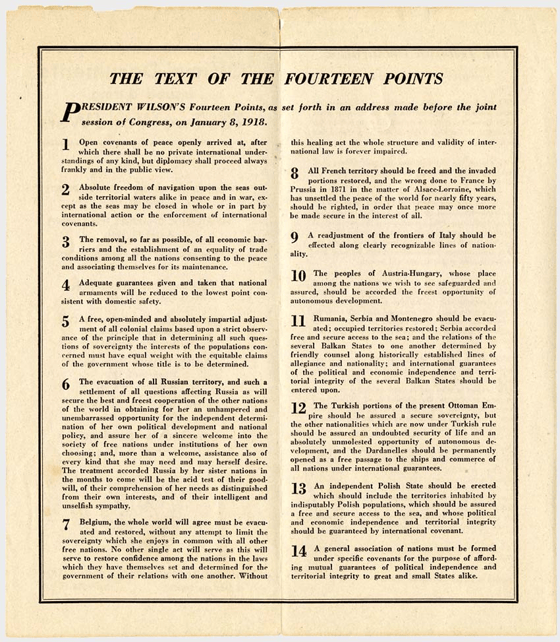
President Wilson’s view was without secret treaties where all of Europe was backing some other country the incident would have been a local affair. Therefore, he reasoned, all treaties should be open and public.
The Fourteen Points energized the minority populations trapped by the Austria-Hungarian Empire. They hailed Wilson as their hero and lauded him with praise and parades as he made his way to Paris for the peace conference. Unfortunately, he admitted, he didn’t deeply understand what he meant. “At the end of 1919, a chastened Wilson told Congress, ‘When I gave utterance to those words [all nations had a right to self-determination], I said them without the knowledge that nationalities existed, which are coming to us day after day” His idealism and this speech credited him with a hope that human society, despite the evidence, was getting better. (Paris 1919 p. 15)
One major result of the collapse of the Austria-Hungarian and Ottoman Empires was a redrawing of the European map along the lines of ethnic identification. The idea of a people having their own country was proposed in Points 10, 12, & 13. Even before the conference was over the Poles, Czechs, and Slovaks were establishing their own countries. Down with the empire and power to the people!
To give time and breathing room to these new democratic states (who would willingly choose a dictator?). Wilson proposed development of international laws that all signatories would abide by. It made sense to him and looked good on paper.
There were other factors. A general loss of faith toward established government created an atmosphere of curiosity and experimentation for something different.
- Competing political philosophies
- Anarchy
- Communism
- Socialism
- Fascism
- Democracy
- Labor and the Union movement
- IWW/Wobblies (Industrial Workers of the World)
- AFL (American Federation of Labor)
- CIO (Congress of Industrial Workers)
- UMWA (United Mine Workers)
- ARU (American Railway Union)
- Growing power of consumerism
- Consumer products (cars, appliances) and consumer credit
Perhaps the biggest large-scale experiment was the Bolshevik Revolution in Russia. We’ll look at that next month. It’s enough to say it spread both hope and fear across the continent and the US.
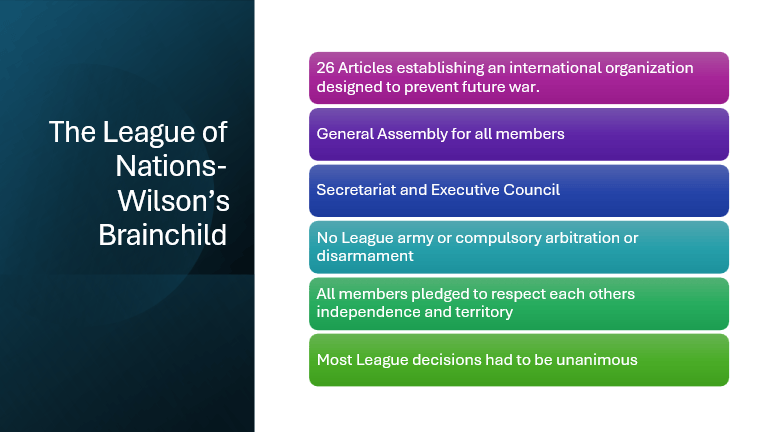
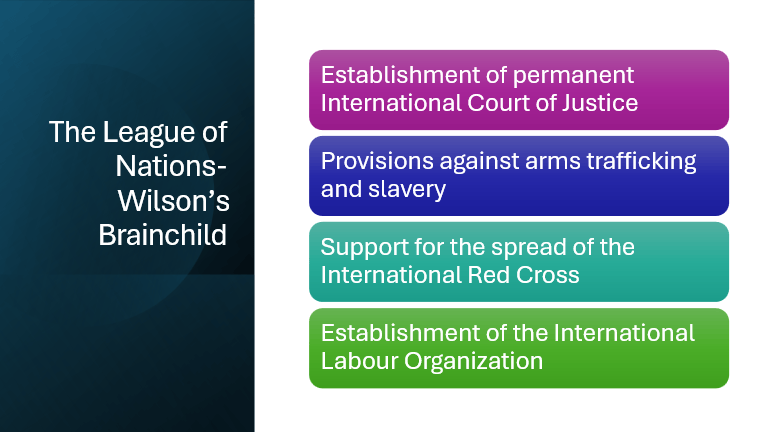
Here’s a quick look at Wilson’s League as approved by the members of the Conference.
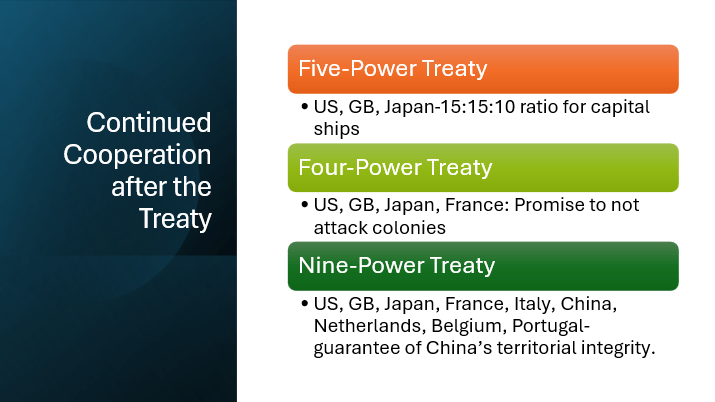
The spirit of the Treaty of Versailles continued through the next decade with a series of conferences in the 1920’s designed to limit the growing naval arms race. Like many treaties they were simply war by other means and the false limits were mixed with the growth of the US and Japanese fleets. On the surface these naval treaties were in the spirit of negotiation and dialogue Wilson proposed.
In a speech before the US Senate praising the treaties and urging their approval, President Harding hopefully proclaimed, “I believe, with all my heart, the powers in conference have combined to make the world [a] safer and better and more hopeful place in which to live.”
Without consulting the Germans, who were forced to sign the treaty, or the Russians who were busy with their own revolution, members of the conference were pleased with themselves. It seemed like a good idea at the time. They had no clue they had sown the seeds for another war, or the conclusion of the one stopped prematurely by an armistice.
Was Wilson naïve? France’s Clemenceau thought so. Britian’s Lloyd George admired Wilson’s ideas but didn’t think the “real world” would support them. Certainly, he wasn’t ready to open the British Empire to self-determination or give up their colonies. John Maynard Keynes, economist and participant of the British delegation thought the final treaty was too harsh imposing a Carthaginian Peace (one designed to crush the defeated) on the Germans. He predicted the economic disaster that fell on Europe as a consequence of the treaty. The arc of history is difficult to see in real time. We react to what we see and know, unable to consider the consequences of our own actions. You could argue Wilson’s idea of negotiation over violence was a blip in time, utterings of a visionary untethered to reality. Many would agree with you and cite the next war and others that followed it in Korea, Vietnam, and the African Independence movement of the 1960’s.
I would propose the United Nations was a better version of the League of Nations. This version took into account the defacto military, economic, and hegemonic power of the victorious Allies at the end of The Great War Part II. No worldwide conflict has erupted in the wake of the UN’s establishment.
The Treaty did many things, and the overall consequence of the negotiations were not limited to another world war. It is true that the harsh terms and consequences for Germany were severe. Likewise, the Japanese expansion into Manchuria only four years later was also, in part, a result of the Treaty, although I would argue the Japanese were going to do it anyway.
Perhaps the Treaty of Versailles ushed in a slow acceptance of international law and some kind of order on purpose. The treaties that ended WWII looked very different than Versailles. The reconstruction of the Axis Powers restored the defeated countries to economic and political power, this time under internationally accepted limits. The economic power of Germany and Japan were acknowledged along with their ascendence within a couple of decades. Military limits were placed upon them, with their consent, which survived until two years ago.
The Bolshevik question proved to be a chimera as labor and worker’s rights were ascendent across the industrialized world. Whether it was an overt communist takeover (Russia) or the growing success of unions like the AFL, CIO, the Wobblies, or the ARU, on both sides of the Atlantic, demands for humane treatment in the workplace and a fair wage. Democratic governments reacted by passing laws to require compliance with a forty-hour week and safety issues. The rise of the middle class is a consequence of these actions.
Nothing happens without an idea, a new aspirational standard. The Fourteen Points and League of Nations embedded into the Treaty of Versailles was that standard.