It’s all the same except the batteries. With all the press about immigration and immigrants, I thought I would look back into American history and see if there was anything we might look at and compare to today. Sure enough, I found the Know Nothing Party. The Know Nothings are credited with cementing the two-party system in the US, which is interesting, but it is their platform that caught my interest.
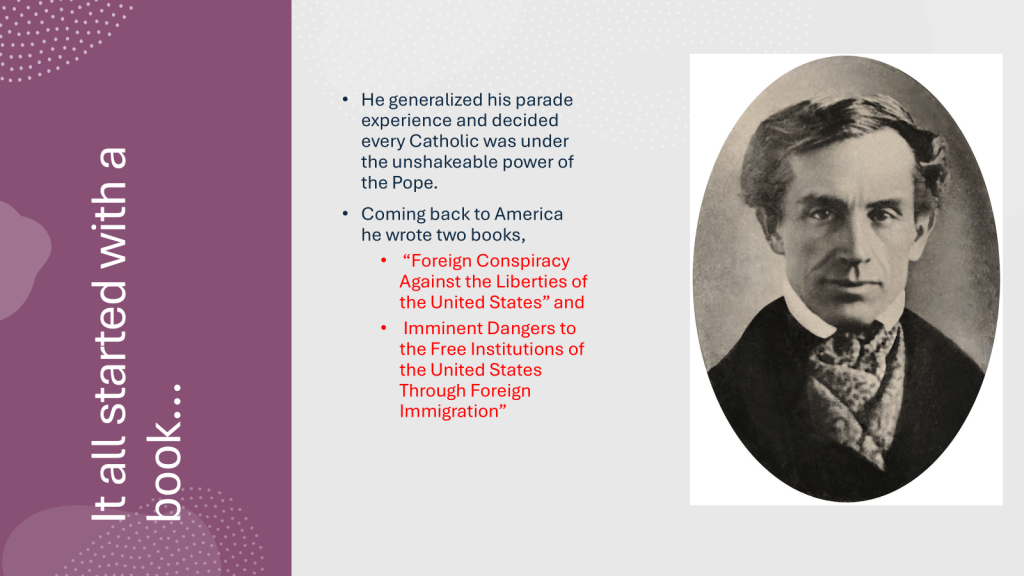
It all started with a rich young guy taking the Grand Tour. On a bright June day in 1830 as he watched a papal procession wend its way through the streets of Rome Samuel F. B. Morse, yeah, the Morse code guy, had a hat clapped firmly on his head . As a New England Puritan Morse had little love for Catholicism, but as an artist he admired its pomp and pageantry—until that day, that is. For, as he watched, his hat was suddenly struck from his head by a soldier, or rather (as he recorded in his diary that night) “by a poltroon (coward) in a soldier’s costume, and this courteous maneuver was accompanied with curses and taunts and the expression of a demon in his countenance.” That this ill-mannered gesture should be blamed on the soldier never occurred to Morse. “The blame,” he wrote, “lies after all not so much with the pitiful wretch who perpetrates this outrage, as it does with those who gave him such base and indiscriminate orders.” From that day the artist-inventor was a sworn enemy of Romanism, and he carried that enmity back to America. (Ray Billington American Heritage)
According to Ray Allen Billington writing for Americn Heritage in February 1959. (https://www.americanheritage.com/know-nothing-uproar) Billington called the publication pornographic for its day.
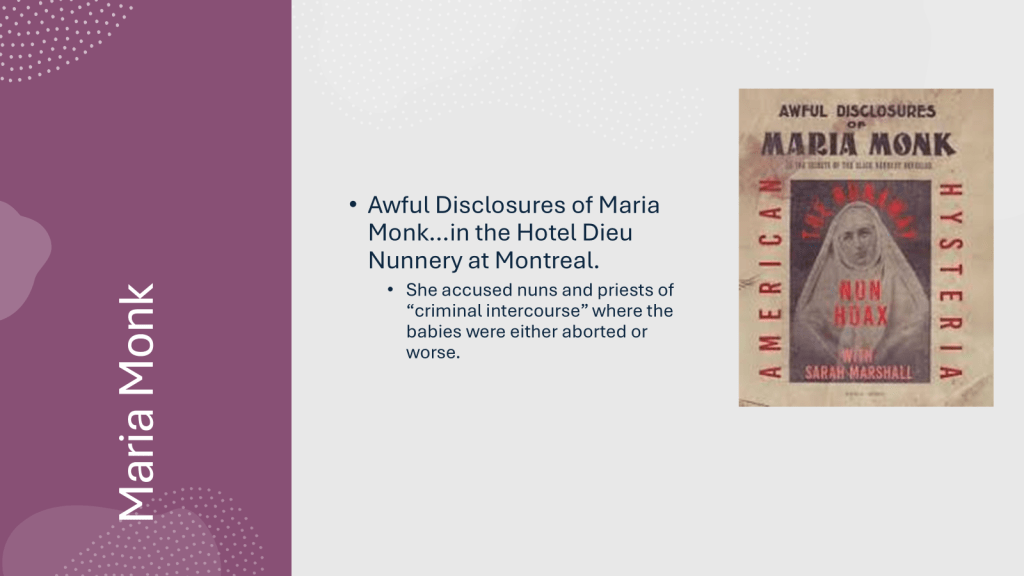
Far away in Montreal, Canada, a young wayward girl who according to her mother couldn’t tell right from wrong, was given over to the Catholic asylum for magdalenas. Ray Billington, writing for American Heritage in 1959, reports the result of her stay was a book called “Awful Disclosures of Maria Monk…In the Hotel Dieu Nunnery at Montreal”. In the book she accused nuns and priests of “criminal intercourse” where the resulting babies were aborted or worse. Billington calls the book pornographic for its day. (1839)
Widely read, these three books prepared the ground for an anti-immigrant, anti-Catholic movement in the United States.
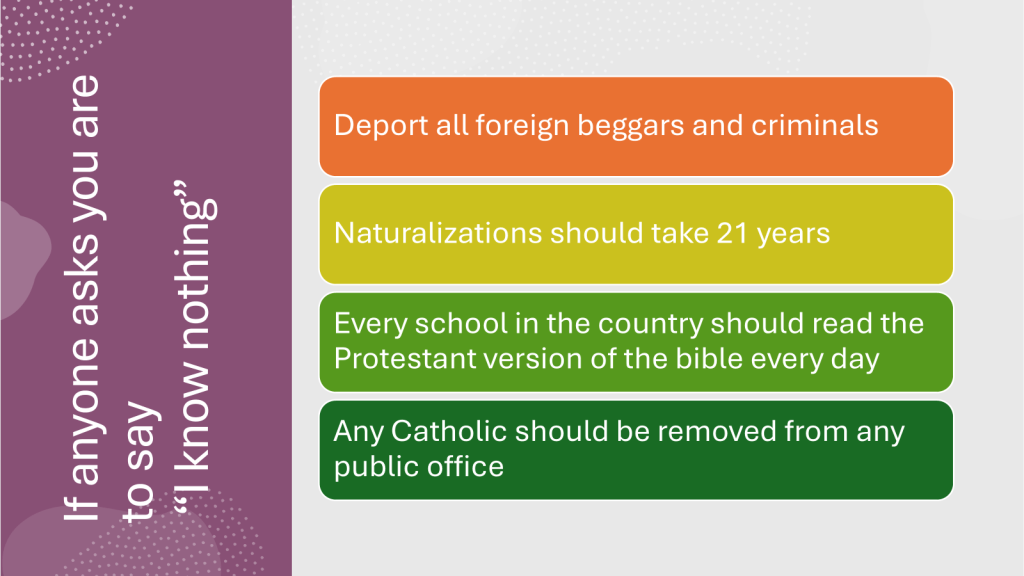
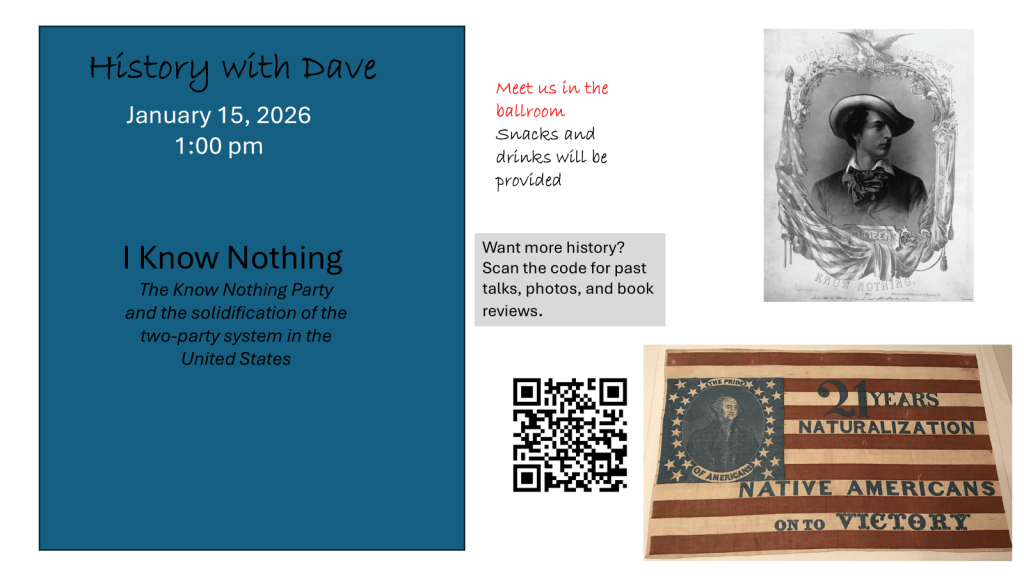
The movement passed from coffee table talk to political action. Backroom conversations and secret handshakes gained momentum but participants were reluctant to come out and expose their xenophobia. They had a secret handshake and secret knowledge to confirm membership. Members were instructed to answer,” I know nothing” if they were asked about the party or its platform. In an ironic way, this became their popular name (their real name was the American Party.)
Their platform rested on two pillars: they were anti-immigrant and anti-Catholic. Here’s what they wanted way back in 1850. Members of the party considered themselves to be nativists. Now that is not to say they considered themselves to be indigenous people like the Cherokee and Sioux, or the other people groups who had been pushed out by the European sweep across the continent. Instead, they were the offspring of those Europeans, English, Dutch, French, etc. They considered the country to be theirs. Although their parents had been immigrants at one point, they did not see it fit to extend that courtesy to others who were newly arriving. In addition to that, they considered the US to be a protestant country. Catholics were not to be considered “good stock.”
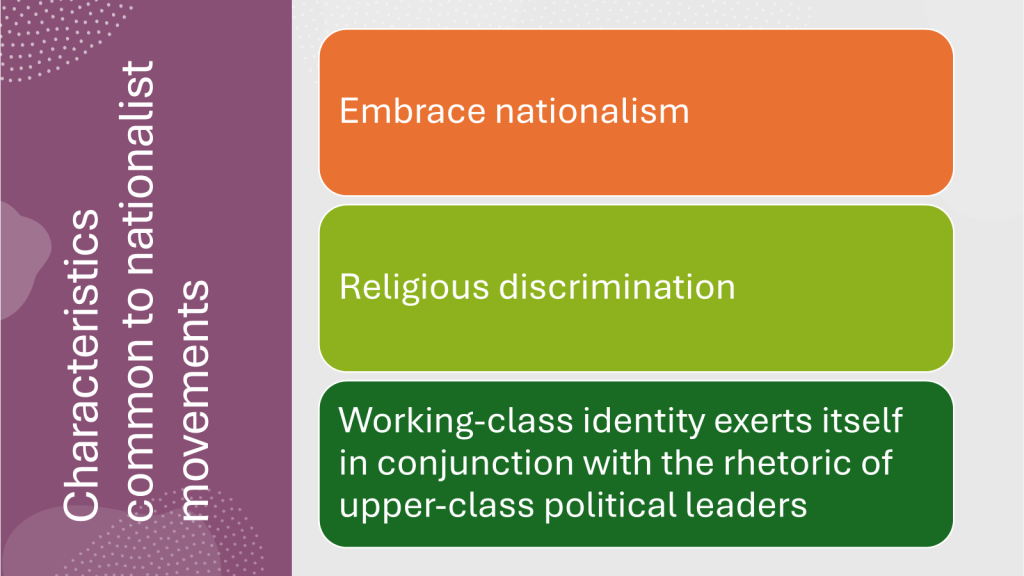
So lets take a look at nativism. Encyclopedia Britanica definition of nativism: nativism, an ideology, governmental policy, or political stance that prioritizes the interests and well-being of native-born or long-established residents of a given country over those of immigrants, typically by advocating or enacting restrictions on immigration. Those who hold this view tend to reject or avoid the term nativist and instead identify themselves as “patriots,” “nationalists,” or “populists.” However, nativism is not equivalent to patriotism, nationalism, or populism; indeed, it has more in common with xenophobia and racism. Here are some characteristics of nativist/nationalistic movements
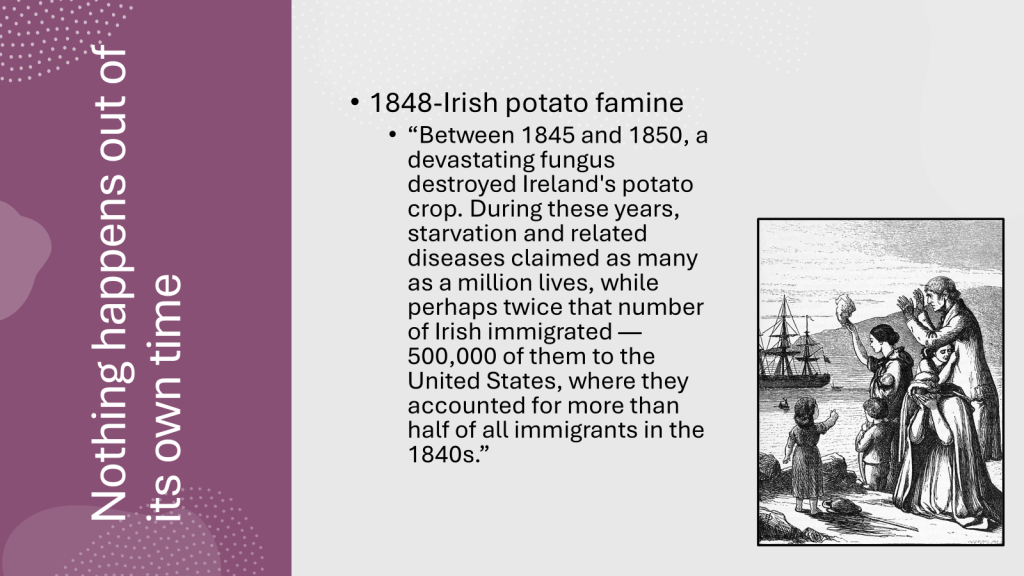
Nothing happens out of its own time, so lets take a look at the bigger picture. What was happening in Europe at this time? Let’s begin with the Irish since they were the largest group of immigrants in this time period.
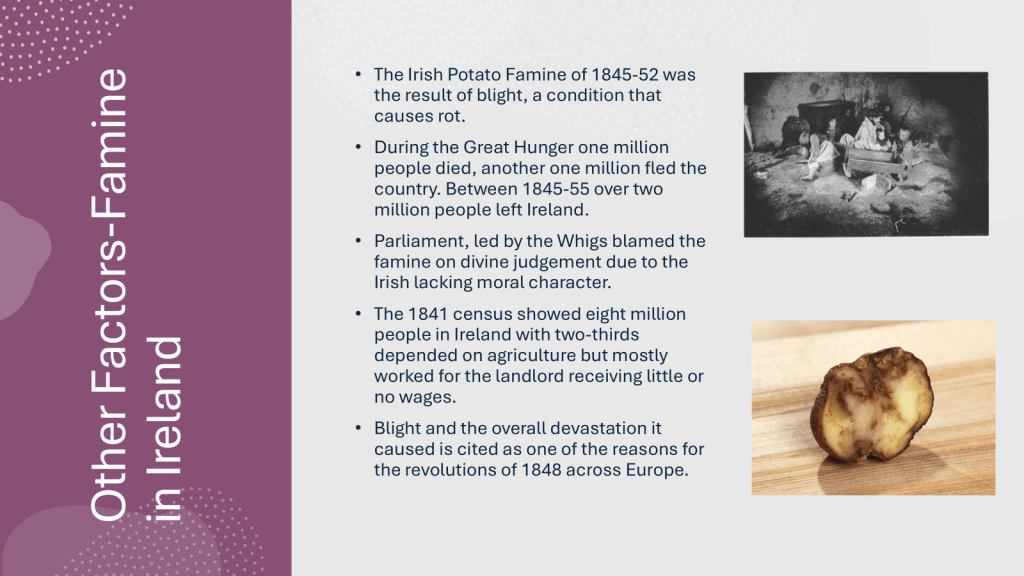
Germany as we know it didn’t exist until 1870. The various German states were part of the German Confederation following the end of the Napoleonic Wars in 1815. Germany, the home of the Reformation, was mixed religiously between Catholics and Protestants with the decision mostly made by the local sovereign during the wars of the Reformation. The big date in Europe was 1848. Unsuccessful attempts at revolution resulted in increased immigration to all the Americas.
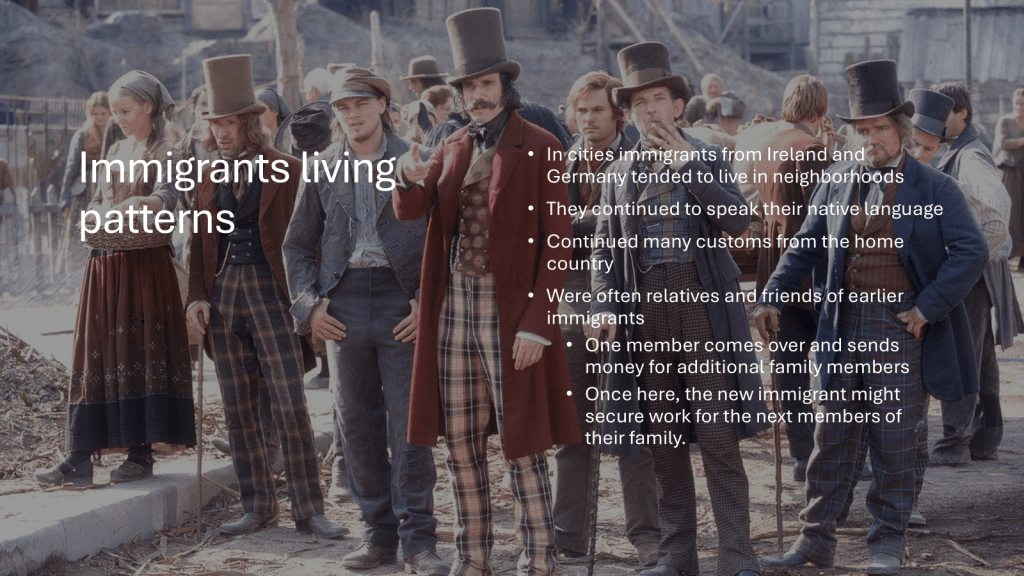
Immigrants in this time period landed in two major cities, Boston and New York. Concentration of new and needy people led to machine politics. New York especially was in the early throes of Machine Politics. By rewarding new immigrants with jobs, the party bosses were sure to be reelected in their parish/districts. Machine politics expanded beyond this simple arrangement to a system where every contract for public services included a fee (bribe) for the elected official to make sure the paperwork went through and the project goals were established along the lines the party wanted. This Machine Politics made sure the “right” people and projects were rewarded and the opposition was starved out of the projects, the graft, and political positions. Think of the Gangs of New York (Martin Scorsese) staring Leonardo DiCaprio, street brawls became common as a way to enforce order in the neighborhoods.
Machine politics survived well into the 20th Century, notably Chicago and New York City.
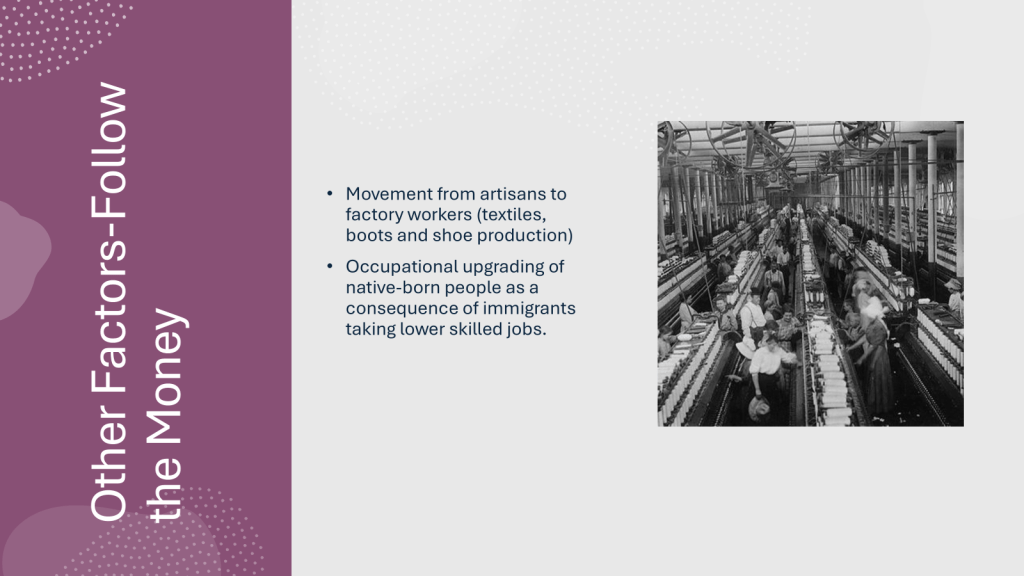
This time period is also the beginning of industrialism in America. Craftsman were being replaced by machines, especially in the textile industry. The skill to operate a loom was different from the skill required to keep an automated loom operating. Consequently, immigrants could keep the machines running with limited training and language skills. For the native born, they were threatened by the influx of foreigners who competed for the new jobs. These issues were addressed in the Harvard study “Understanding the Success of the Know-Nothing Party.” The authors concluded (using economic analysis models and numbers) that the real effect of immigration was neutral. Hence, like today, it was the perception, caused the the number of persons over the short period of time, rather than the actual consequence of immigration that set up the Know-Nothing’s animosity toward Irish and German immigrants. Did the native born feel like they were being overcome by foreigners? Yes. Did it effect their job prospects of dilute their franchise? This article shows it did not.
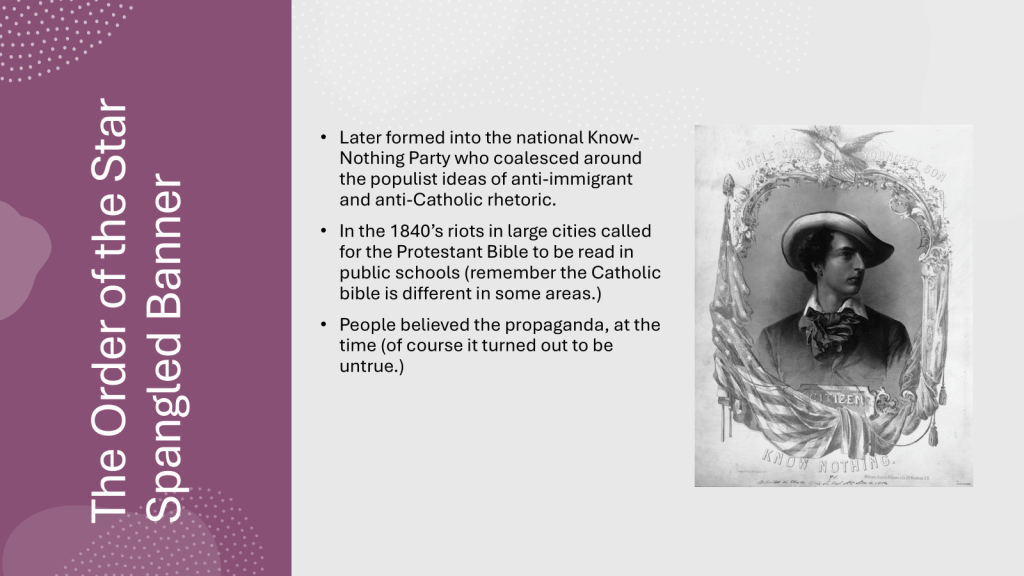
Samuel Morse’s idea that the Pope and European monarchs were out to get the US was untrue: The Catholic Church and the Pope were not organized against the government of the US. Monarchs did not coordinate with the Church to direct any action against the US. In fact, due to the French Revolution and the aftermath of the continent-wide conflict, monarchs were doing everything they could to limit democracy and reestablish hereditary monarchy, especially in the territories controlled by the Hapsburgs.
Here in the US a gathering place for the nativist crowd was the Order of the Star Spangled Banner, later renamed the American Party. To history they would be know by their reply, the Know Nothings. On the slide you see the call for reading the Protestant Bible in schools. Aside from the Separation of Church and State issue, the additions in the Catholic Bible were the concern. The Pope was out to brainwash the citizenry.
We looked at some of the push/pull factors that made the US an attractive place to land in this time period between 1840-1860. Big changes were happening here in the US that made immigrants an easy target. In the past we’ve looked at how slavery was much more than a moral issue. The power of the South to set the country’s agenda in the decades leading to the Civil War was a direct consequence of the economics of slavery. Furthermore, the Constitution gave political advantage to slave holding states. It was this issue and the refusal to take a stand on it that caused the downfall of the Know Nothings.
Here are a few markers to keep in mind. We’ll come back to the political party situation in a few moments. It is important to note that the emergence of the American Party led to a loss of faith in the second party of the republic, namely the Whigs. With the failure of the Know Nothings to hold, the prospect of a true third party in the US was rejected ensuring our two-party system.
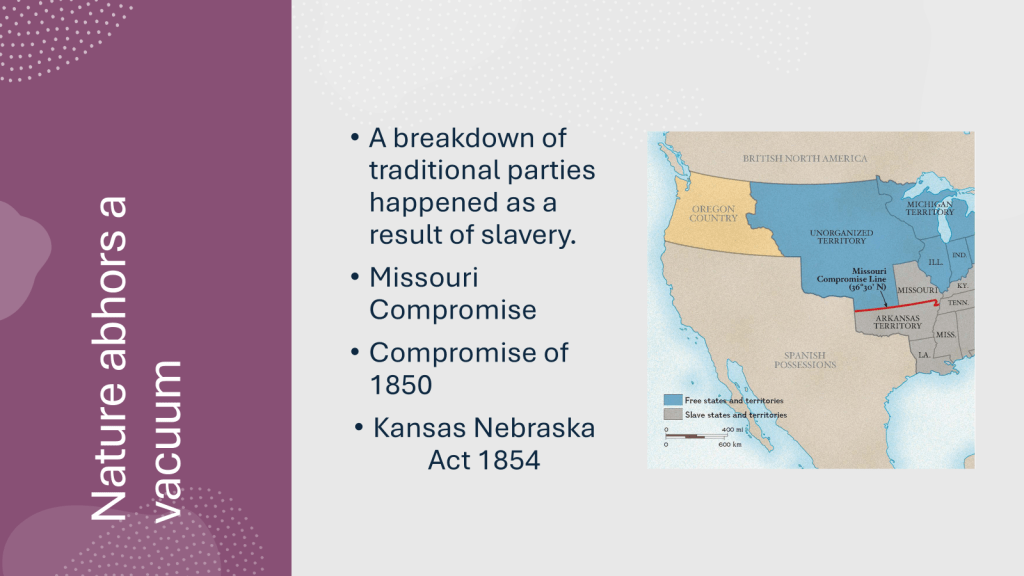
Upheaval caused by expansion across the continent-into the areas of the Louisiana Purchase and the territory gained from the Mexican-American War forced the slavery issue.
Beginning with the Missouri Compromise of 1820. To maintain Congressional balance in the House and Senate Missouri was admitted to the Union as a slave state. It was balanced in Congress (the Senate) with the admission of Maine as a free state and set a line at 36 30 as a hard “no slaves” line for future states. Next was the Compromise of 1850, It was actually five bills that addressed the new territory gained from the Mexican-American War of 1848. 1) California entered the Union as a free state, 2) Strengthened the Fugitive Slave Act , 3) Banned slave trade in Washington DC, 4) Defined the boarders of Texas and established a territorial government for New Mexico, 5) Established a government for territorial Utah with no restrictions regarding slavery. Under the new laws, the white residents of the territories would decide the slavery question for their territory/state.
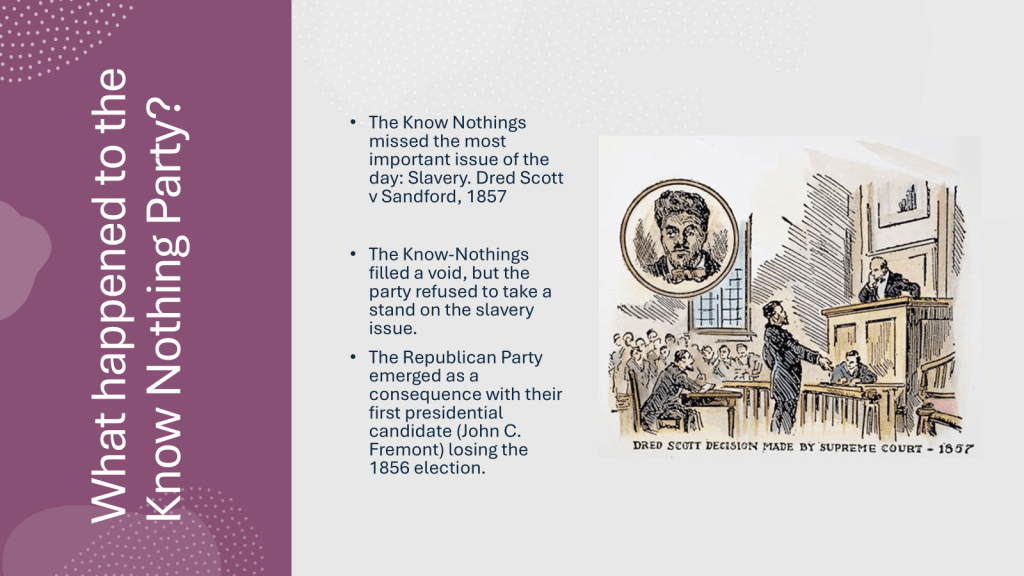
The compromise had barely been settled when the issue of Kansas came before Congress. The Kansas-Nebraska Act overturned the Missouri Compromise of 1820 making the decision to become slave or free (both new states north of the 36/30 line) a local issue. It was a consequence of the coming transcontinental railroad and resulted in people being temporarily trucked in to vote on the issue. The last major issue in this era was the Supreme Court decision in Dred Scott v. Sandford. Dred Scott sued for his freedom when his master took him to Illinois and the Wisconsin Territory. He argued that once within the territory he was no longer subject to the slave laws in his home state of Missouri In one of the worst decisions made by the Supreme Court, Chief Justice Roger Taney led the court’s decision that Scott could not bring suit because neither he, not any person of African ancestry could claim citizenship. The Missouri Compromise, Taney argued, was unconstitutional because it deprived citizens of their property without due process of law. The property in question were his slaves.
As Congress struggled with the question of how to reconcile the words of the Declaration with the political reality of slavery, they made a series of compromises intended to solve the slavery question. As the allowable territory for “the peculiar institution” was surrounded and limited, part of the population turned to an issue they thought they could control: Catholic immigrants.
This explains both the rise of anti-immigrant, anti-Catholic setiment and the reason for its brief surge of political power.
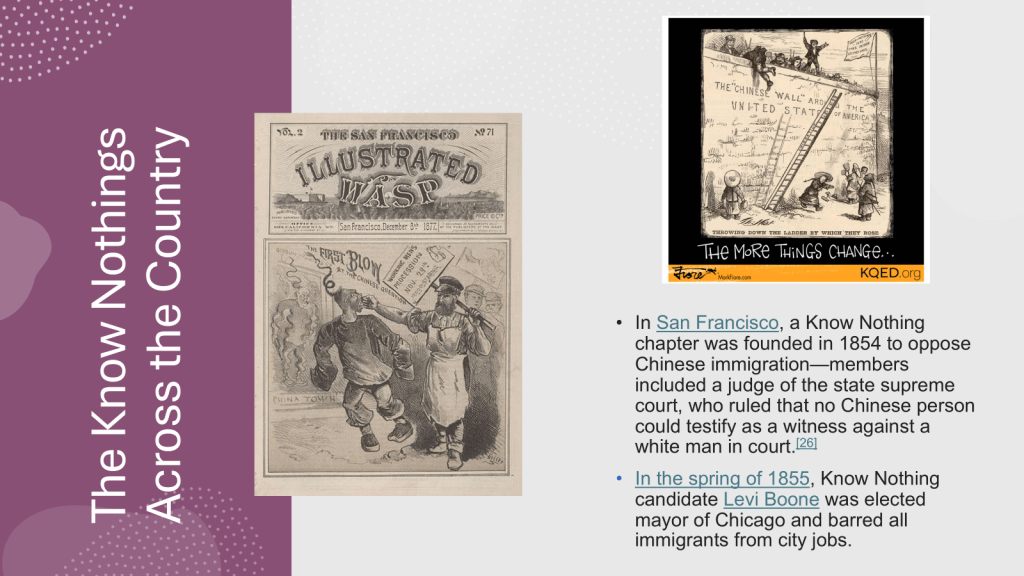
Immigration and immigrants have been a recurring opportunity for politicians and political parties throughout our history. Here are a few lowlights.
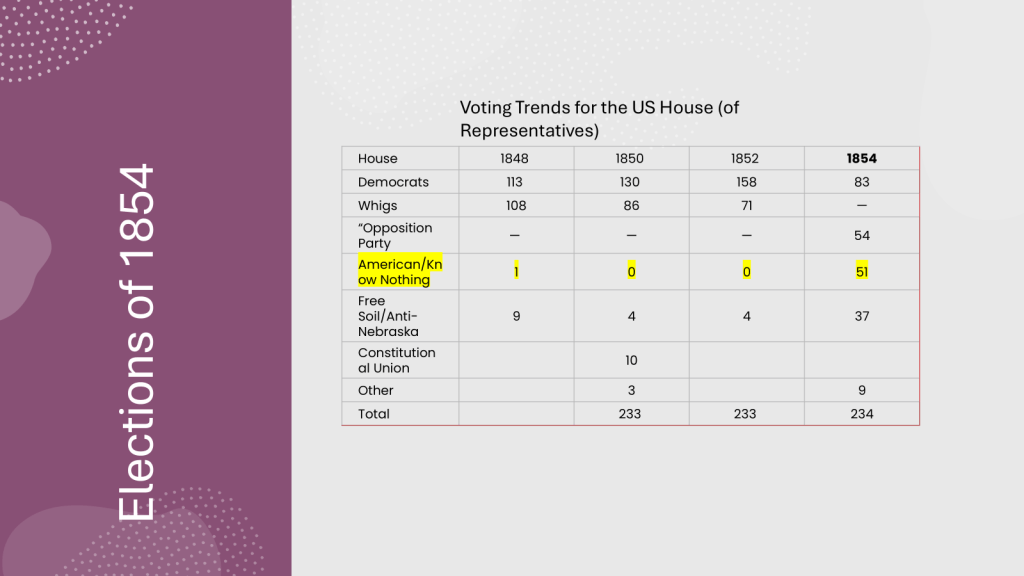
The party gained members throughout the 1840s and 50s with its highest political effect in the off-year elections of 1854. What political success did the Know Nothings see? Here are a few charts that help answer the question.
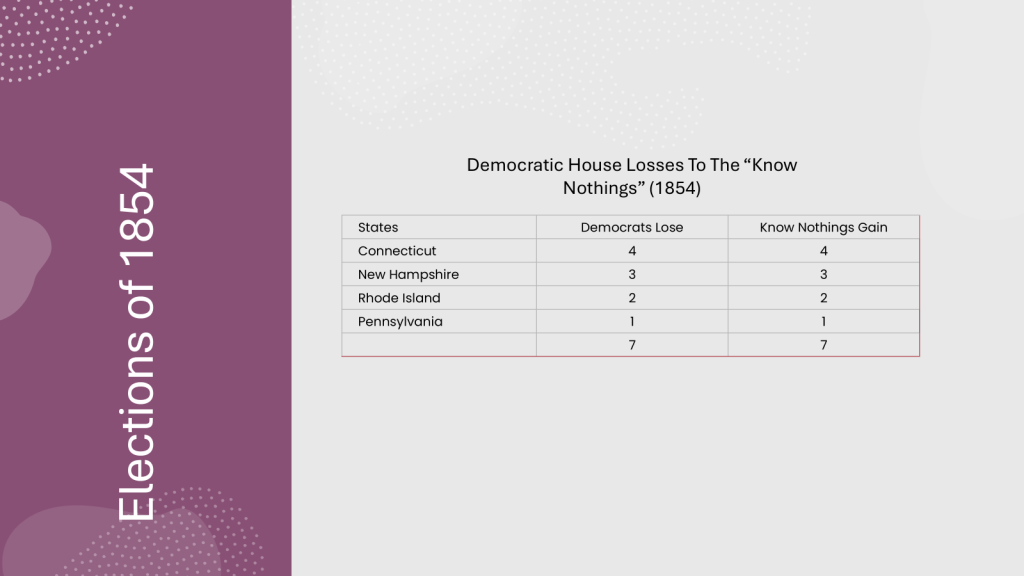
The most startling and abrupt Know-Nothing victory occurs in Massachusetts, where all twelve House seats went to the Nativists, along with the governorship, won for the first of three times by the ex-Whig, Henry Gardner. Conjecture has it that the anti-immigrant backlash in the state traces to it deeply Protestant Puritan roots and fear that the Irish would undercut laborers employed in factory jobs.
Several Slave states, most notably Kentucky and Tennessee, also swung into the Know Nothing column in the House, and other local races exhibited their sudden rise.
Robert Conrad’s success in Philadelphia was matched by mayoral wins by Know Nothing candidates John Towers in Washington, DC, Levi Boone in Chicago and Stephen Webb in San Francisco. California elected J. Neeley Johnson as its Governor, and two soon-to-be powerful Republicans enter the 34th Congress wrapped cynically under the Nativist banner. One was the strident abolitionist, Henry Wilson, who won a Senate seat in Massachusetts as a Know Nothing; the other, Schuyler Colfax, also anti-slavery, entered the House.
In the end, the Know Nothing Party phenomenon will burn brightly in 1854 and then, much like the Anti-Masonic Party of 1828, be overtaken by the nation’s more urgent sectional conflict over slavery.
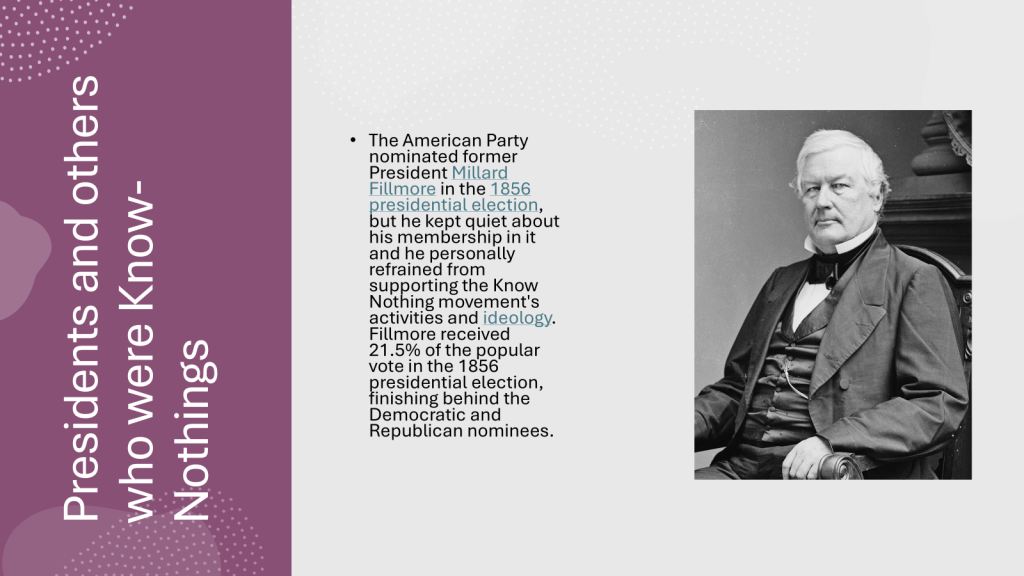
By 1860 the Know Nothings were extinct, replaced by the Republicans. In large part because they refrained from taking a position on the major issue of the day: slavery.
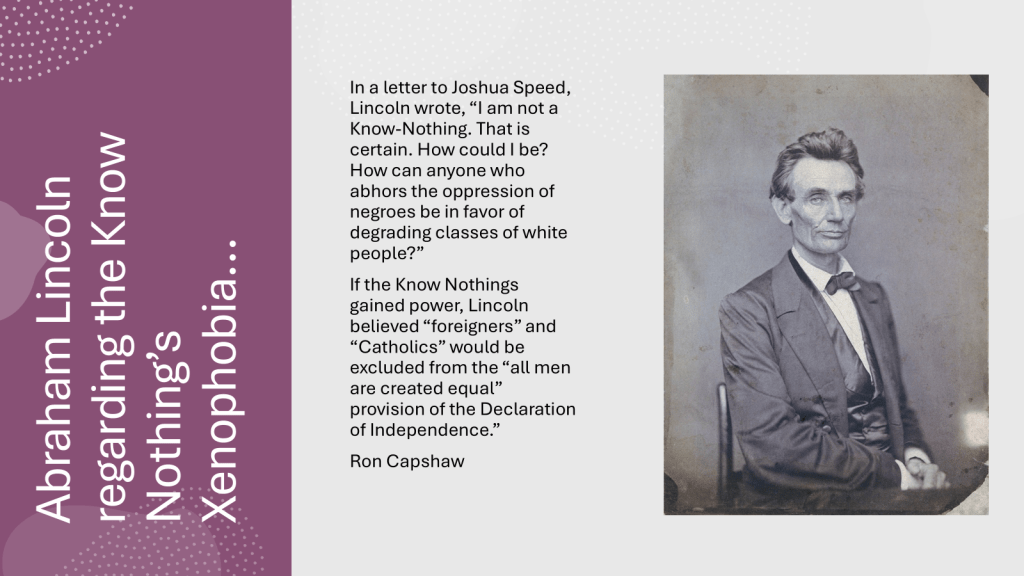
Lincoln’s statement… brings us to the political party influence of the Know Nothings. By 1840 the Whig Party, which replaced the Federalists (a conservative party) began to lose touch with the electorate. Unwilling to address the moral aspect of slavery, a growing group of abolitionists looked for a political stance that would support the end of slavery throughout the country. The Whigs were busy crafting legislation and compromising for the sake of retaining the union on a political basis. It would be an oversimplification but true statement that the Whigs were about the power to make change or hold the status quo.
The Republicans were founded around the idea of abolition. That’s not to say the members of the new party had a clear idea what to do with thousands of freedman. The idea that Africans were inferior to whites was ubiquitous. Among the ideas floated at the founding of the party was to send all the former slaves back to Africa in a colony where they would establish a democratic government. That area is today’s nation of Liberia (1847).
The formation of the Requblican Party, which many Whigs joined, combined with the Know Nothing’s refusal to take a stand on slavery to doom the party.
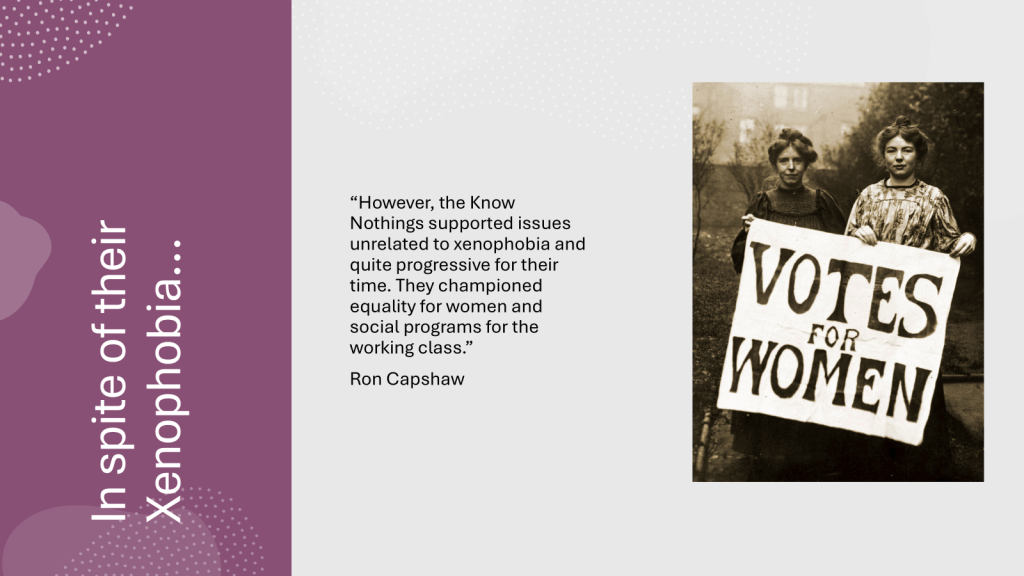
They weren’t all about xenophobia. They supported issued unrelated to the nativist ideal and were quire progressive for their time including championing equality for women and creating social programs for the working class.
The idea that some of the scape-goating seen with the Know Nothings has returned in our time s addressed by Ron Capshaw in the May issue of Liberty Magazine. You may want to search the article in your browser.
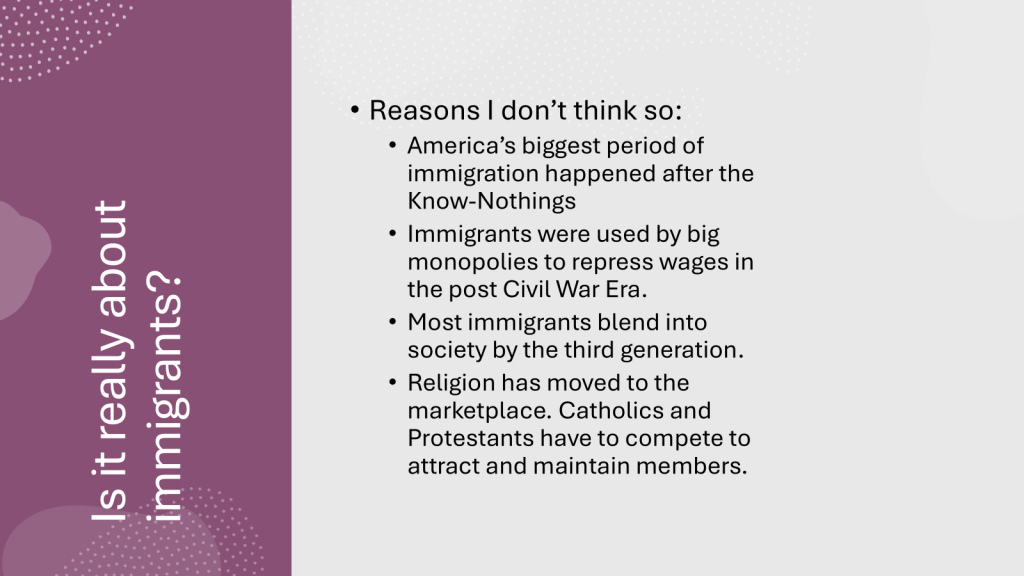
The Know Nothings were on to a deep seeded issue. It looks to me like immigration and immigrants are a smoke screen for bigger issues and always have been. It’s about economics, religion and the tribe mentality.
Consider this: Americans biggest immigration was in the post Civil War era, long after the Know Nothings were a potent political force.
The same era of immigration was used to suppress wages by the emerging monopolies now known as the Robber Barons. The answer to low wages turned out to be unionization and the government making a 180 turn to support workers instead of the heads of business.
For those Europeans who could blend in with society the country accepted them as the new nativists.
In the later 20th and early 21st centuries religion has moved to the marketplace where Catholics and Protestants compete for time and affection with all the other distractions of society.
It could be economic (jobs and money) or it could be political, loosing a sense of agency on our own life and the life of our family and loved ones. Overall, I think when people felt helpless to make things come out well, they look for someone to blame.
The Know Nothings missed the issue of their day. It was slavery. Their core anti-immigrant anti Catholic message had high emotions but no staying power, at least not politically. So, with today’s anti-immigrant climate, what do you think is today’s issue?
Is it a stretch to say ICE is the enforcement arm of modern day Know-Nothings? A casual look at the actions of ICE reveal the first criteria for stopping a person is their skin color. The news is full of actions taken by ICE agents that are devoid of any Fourth Amendment rights, no checking on citizenship, no due process. Detention or death (in some cases assassination) without the benefit of the courts or even a search for the truth behind the suspect’s citizenship.
The Know-Nothings had a big following in the 1850’s. I thought maybe the actions and attitudes they took had been replaced by more reasonable and open-minded people. I actually thought we had made progress and decided to embrace “All men are created equal”, as close to a creed as the US has. But the reelection of a President who showed little respect for the law in his first term, the clear promise by his backers from the Heritage Foundation via their publication “Project 2025” to carry out the racist ideas of limited citizenship originally expressed by the Know-Nothings have demonstrated these narrow and prejudiced ideas still exist. Not only are they ideas alive and well, half of the voting citizens in the country embrace the government doing whatever is necessary to treat people of color (black or brown) with any force required to export them to anyplace the wicked administration desires. In my enlightened little brain I thought the Court of Congress would stop the actions of such a narrow minded man, but alas, they are right there with him.
History isn’t repeating itself here. The power of the Know-Nothings was limited by the circumstances of of their day and by the extremity of their position. It’s time for the good people of our day to put a stop to the actions of ICE and the administration that gave power to this anti-American view.