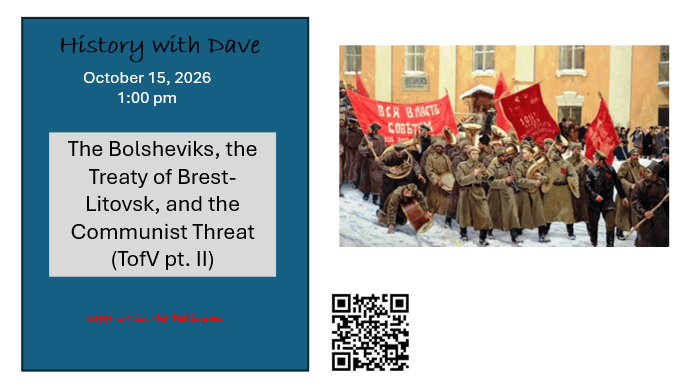
When a revolution doesn’t go well and the public still hates the policies carried over from the past, the time is ripe for a steal! The crumbling Russian Empire was in that position in 1918.
Russia remained a country primarily made up of peasants, small farmers working plots of land usually owned by someone else. The Enlightenment had largely passed them by, so had most of the industrial revolution. The upper class wanted reforms and tried a few times in the 19th century to wrestle them from the king but progress had been slow compared to the West. The shocking defeat by Japan in 1905 led to revolution and a general strike. Czar Nicholas II responded by calling the Duma, the Russian parliament. In spite of the crisis and subsequent exposure how backward they were, members of the Duma couldn’t agee how to proceed. Consequently, no progress was made toward democratization. When the Great War started in 1914 everyone fell in line behind the flag and the Czar. Underlying issues didn’t go away, however. They continued to simmer under the surface.
Unlike the highly industrialized west, forced conscription of peasants, the financial toll of the war, and the lack of military success led to a new revolution in February 1917. Like each of the combatants in the Great War, the Russians were enthusiastic. Like the others they thought it would be over in six months. The Russian army was built around a fast and nimble infantry with its light artillery. As the war progressed and bogged down to trench warfare they failed to scale up the size and tonnage of the new guns. France, for example, ended up with artillery on trains. Big Bertha could throw a one ton shell one hundred miles. It is estimated 75% of casualties were caused by artillery. The Russian military strategy could be summarized by one of the generals words, “bullets are dumb, the bayonet is smart.” Many soldiers would never get close enough for the bayonet. By early 1917 the pressure errupted into a revolution. It resulted in the abdication of the Czar and creation of a temporary government designed to last until elections could be held. A fateful decision was made by the Provisional Government led by A.F. Karensky to remain in the war. The decision was a result of the pressure campaign by the Allied and Associated Powers to keep the eastern front open. (As we learned last month, the way to defeat the Germans is to have them fight a two front war. With Russia’s massive population, they pay in human lives what they can’t pay in military material. Not learning from Napoleon’s unsuccessful conquest, the Kaiser and Hitler both got their turn to be overwhelmed by Russian troops and weather.)
Consequently, the pressure of the Great War remained as the new Provisional Government tried to right the Russian ship of state.
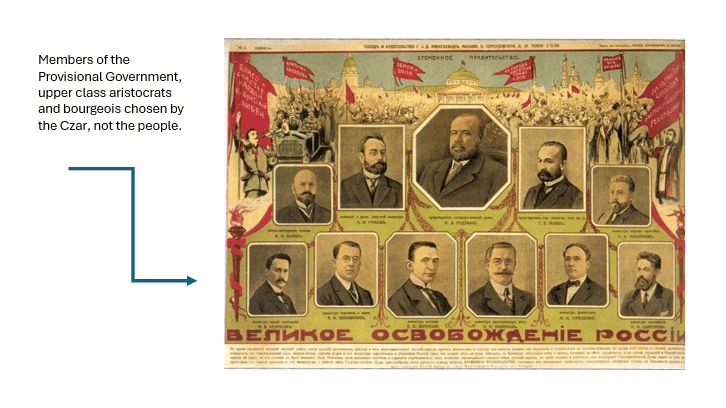
In March, a Provisional Government was founded with the objectives to, oust the Czar, remain in the war, and eventually, establish a republic. According to the St. Petersburg Encyclopedia, the PG was actually a series of governments that contained a rotating list of members trying to shore up the failing situation in Russia. Among the things they did to stop the overall societal crisis was monopolize the bread industry, an example of the depth of the crisis.
However, they were unable to stop the decent of Russian society into anarchy. The continued crisis opened the door to one brand of soviets who called themselves Bolsheviks. In October, they effectively stole the revolution and made it their own.
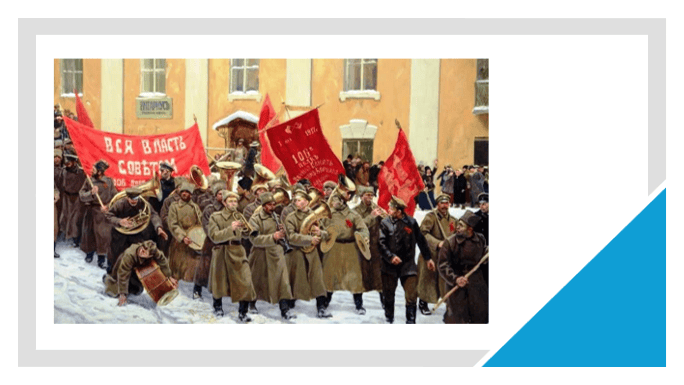
It only took from February to October for the worsening conditions, munity, and starvation at home and the front to present the Bolsheviks with an opportunity to seize the reins of government. The war created the crisis and Lenin, Trotsky, and associates used it as their battle cry, “Peace, Land, and Bread,” they proclaimed. “The Capitalists have fomented this war that is costing your husbandsand sons, starvation, and a life of misery. We will End the War!” They promised.
And that is what they did. They contacted the Kaiser’s government and requested terms of peace. The treaty was negotiated and signed in the city of Brest-Litovsk, today in Ukraine. The treaty gives us a chance to see what the Germans demanded to end the war and as we will see it wasn’t very altruistic. It held to the old-world rules, “to the victor go the spoils.”
Nothing happens out of its own time. Comparing the two ends of the war treaties reinforces this truism. As we will see, the sole difference between the two was the League of Nations and the attempt to agree on a set of international laws for countries to abide by and base their relations.
I don’t want to hold up the Bolsheviks and their communist government as something to emulate. The repressive regime under Lenin, Stalin, and Khrushchev sacrificed Russian people, 3.3 million for purely political reasons and another 10-20 million due to famine and policies and that led to premature mortality. The intraparty actions, self dealing, and economic privileges look surprisingly like machine politics or the good ‘ol boys network self-dealing at the expense of everyone else. Unable to gain power at the ballot box, in the November 1917 election, they came in second with 23.9% of the vote behind the Socialist-Revolutionaries at 40.4%. They were not democratically elected into power. Their response was to dissolve the Assembly in January 1918, a move favored by totalitarians (Wikipedia). You may recall the Nazi’s never had more than a third of the German assembly resulting in the elimination of the Reichstag. From a purely academic point of view, the conditions Marx and Engels laid out for the Communist revolution were never present in Russia. The attempt to force the communist ideal on the vast Russian society was brazenly more totalitarian than anything in the Manifesto where workers decide to take over the reins of the economy and government.
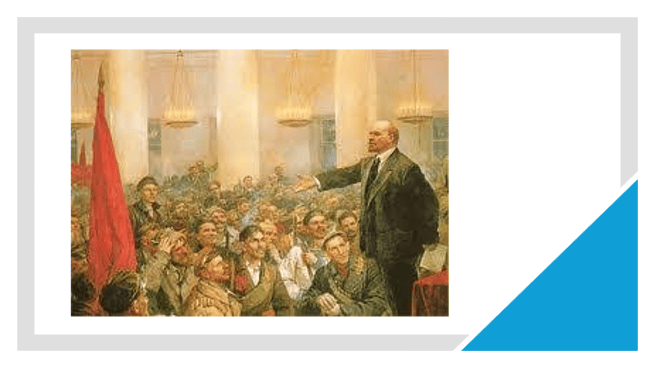
Lenin, leader of the Bolsheviks, knew his revolution was on the same shaky ground the Provisional Government had been. A mere declaration wasn’t going to give him the reigns of power. His first step in cementing his party’s power was to get out of the war. His offer to the Central Powers (Austria and Germany) to end the war was swift, by December he was in talks. He decided to take whatever terms the belligerents wanted. The Bolshevik high command didn’t agree with him causing a split, but he threatened to resign and they relented. Encyclopedia Britanica records the terms of the treaty signed on March 3, 1918 “Russia lost territories inhabited by more than one-quarter of its citizens and providing more than one-third of its grain harvest. It also exempted citizens and corporations of the Central Powers from Soviet nationalization decrees.” Russia was to pay Germany six billion marks in reparations. (Treaty of Versailles demanded $33B from Germany-paid in full in 2010.) In a supplemental agreement the Germans agreed to come to the Bolsheviks aid if the Allied Powers took actions against the new regime.
A map of the territory will give us a look at the extent of the eastern victory the Treaty of Brest-Litovsk represented for the Germans.
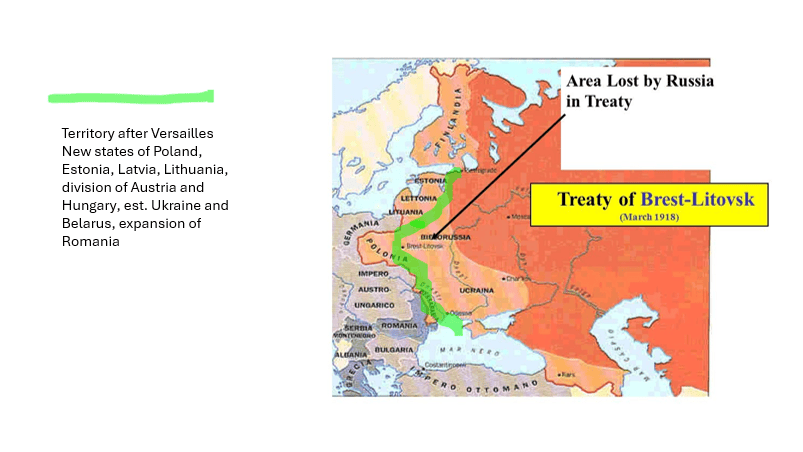
The treaty was signed in March 1918 a mere four months after the Bolshevik coup. Lenin and his comrades had much to do to shore up their power, but this isn’t about the Russian Revolution. While the treaty allowed the Germans to eliminate the eastern front and secure much needed food for its citizens and army, the general conflict was over a mere five months later with the Armistice on 11-11-18. The Treaty of Versailles nullified all the German gains from Brest-Litovsk.
Outside of the League of Nations foundation the work at Versailles followed two previous trans-European treaties, that of Westphalia in 1648 and the Congress of Vienna in 1814-15. Both of those treaties created a new map of the continent and punished the losers. The Treaty of Versailles did the same, the 1922 map of Europe is radically different from the 1914 version.
Wilson’s Fourteen Points had virtually invited leaders of nationalistic movements to the table to ensure their inclusion in the new land grab. Forefront in this redrawing of the lines was Poland. Polish nationalists had already carved out a piece of their historic country before the end of the Versailles conference. By blaming Germany for the war, much of the reassigned territory would come from the now vanquished Central Powers (Germany and Austria-Hungary.) The rest came from the not invited Russians and, as we see on this map, some of the territory changes from Brest-Litovsk. Even though Versailles nullified the Treaty of Berst-Litovsk the changed territorial lines were incorporated into the reformed map.
Territory remained a German issue even after the war. Two pillars of Hitler’s demands leading up to WWII were liberstraum (living space) and access to additional food. His invasion/take over of Czechoslovakia in 1939, given to him in Munich in a treaty with Chamberlain who declared,“Peace in our time” and the invasion of the USSR in 1941 to secure the rich farmland of Ukraine demonstrate those two ongoing goals.
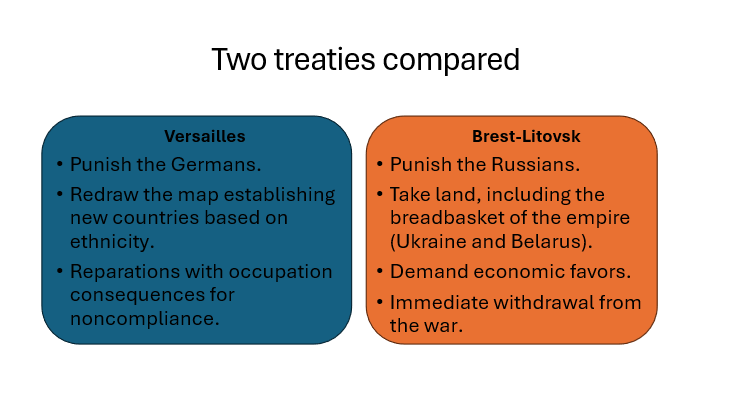
Last month I proposed the 20th century was an experiment by nations to agree and abide by a set of international laws. I acknowledge there are some big exceptions, but on the whole, nations agreed to play by a loose set of rules. Those rules were sketched out by President Wilson in his Fourteen Points and renewed with the United Nations Charter in 1947. Wilson was seen by France and England as extremely naïve in his efforts to secure the League as the end-all of international conflict. In the spirit of the losers pay, France especially wanted their pound of flesh from the Germans, both for the humiliation of 1871 and the massive loss of life on the Western Front. One of the biggest faults of the peace conference was the absence of the conquered nations and subsequent blame, a clause everyone at the table knew to be blatantly false. The Treaty of Versailles was not a negotiated peace, it was the final conquest of the Allied Powers, one completed with the pen instead of the sword. With the exception of the League of Nations, Versailles was in the spirit of Westphalia and Vienna: the conquered had to pay and to the victors go the spoils.
Did the Germans act differently? No. They took what they wanted and didn’t care much for any negotiation from the Russians. Of course, the Russians, actually the Bolsheviks who were not representative of the entire body politic of the empire, simply capitulated with no desire to get a just conclusion to the war. It’s not unreasonable to think they just decided to deal with the border issues etcetera later after they had seized control of the government. Their efforts were better spent shoring up their base and fomenting the proletarian revolution that would encompass the entire continent. Its success and the establishment of a communist state would be the spark of the continental-wide transformation predicted by Marx.
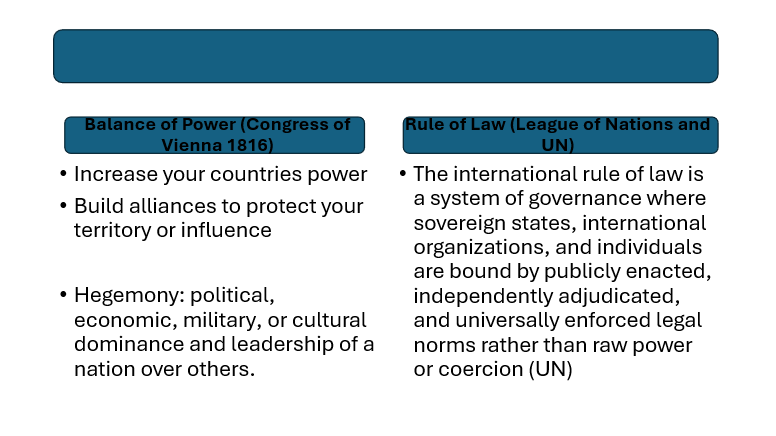
Today, I think we are witnessing a replay of the old ideas. The prewar world was based on balance of power, one where the major powers get their share of the goods by force and acknowledging hegemony within geographic spheres of influence. Balance of Power rests on the military and economic might of the major powers. Not only does the strength of each major power stand as a check, each major player has a regional sphere of influence. This results in a “hands off” agreement between hegemons. Essentially, this is a “stay in your lane and I’ll stay in mine” agreement.
A world based on International law is different. In the world of law even the little guys get to play. The rules apply to large and small countries alike. With the rule of law, respect of territorial integrity is accepted by strong and weak powers. Without ignoring the unwritten laws of economics (thank you Adam Smith), each country can see their relative position and the pathway to more influence and economic self determination. Under the Balance of Power regime, little nations do as their told and don’t ask questions or demand equality. In the world of the hegemons, little players do as they are told. The conflict between raw power and respect under the Enlightenment idea all men are created equal plays out in the community as well as in international relations. Do minority groups and individuals have to wait for power institutions to grant them permission and then be careful not to lose favor and rights or does everyone get an equal opportunity to contribute and determine what the rules will be and how they will be enforced? You would be justified in thinking that like Wilson, I was naïve if I really thought the altruistic ideas about true equality is something to be grasped. Like Jefferson’s words, the idea all men are created equal is something to aspire to. Sometimes the right thing happens and women get the right to vote, former slaves receive full citizenship, and power brokers either use their power for good or they are forced to cede some of that power for altruistic reasons.
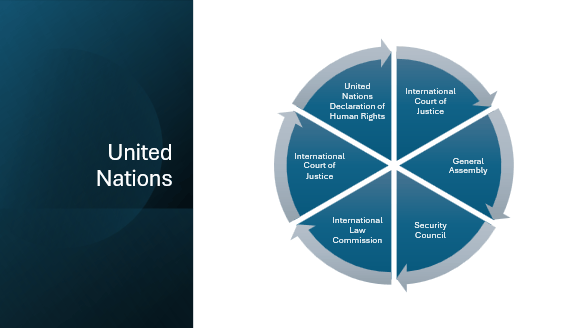
The UN Charter- a reset of the League of Nations- was written with US ideas in mind; American rules for an American century. Its objectives are: Maintain international peace and security, develop friendly relations among nations, achieve international cooperation, and promote human rights. The UN has forums to help nations behave themselves: the International Court of Justice, the General Assembly, Security Council, International Law Commission, International Criminal Court, Geneva Convention, United Nations Declaration of Human Rights.
Power at the beginning of the twentieth century was shared by strong powers in an agreement that was intended to balance and check each of the major players. The balance created by the Congress of Vienna held for one hundred years and extended to Africa and Asia where territory was divided up by major colonial overlords. China was divided and subservient to the major European Powers and the US.
When that system collapsed at the end of the war (kings in Austria-Hungary, Germany, the Ottoman Empire, and Russia all fell before the war ended) Wilson and the various nationalities in Europe tried to remake society along democratic ideas that relied heavily on the rule of law and separation of powers. To that end an international body, or league, would replace the old Balance of Power agreement. Nations would adjudicate and negotiate their differences. The basis for resolution would be international law the respected national sovereignty.
The rekindling of the war between 1939-1945 further strengthened the importance of an international body and agreement for everyone to play by the rules.
It worked for a while.
What I see in the news is a return to the old Balance of Power idea. I guess we get a front row seat as the shift away from international law moves toward the will of raw power.