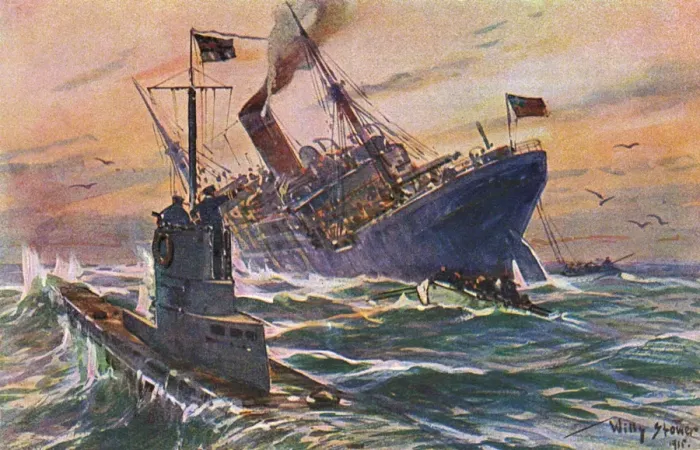
World War I didn’t go well for anyone. Experts on both sides thought the conflict would be over in six months. Instead, it dragged on for almost four years. Somewhere between 15-22 million military and civilian deaths was the cost of war with perhaps another 21 million wounded. Needless to say, it didn’t go according to anyone’s plans. As the conflict drug on into 1917 both the Allied and Central Powers, exhausted by the cost in men and material knew the side the United States joined would almost certainly win. America’s commitment to neutrality had been slowly changing throughout 1916 in favor of the Allies. It wasn’t because of any intrinsic favoritism; President Wilson was careful to walk a middle line because an open immigration policy during the 19th century had resulted in a polyglot of ethnicities scattered throughout the country. The Germans were as good a citizen as the English, all were simply Americans. Three words explained the change, unrestricted submarine warfare.
After the RMS Lusitania incident on May 7, 1915, where the passenger ship sank in about eighteen minutes with a loss of 1,197 lives after being torpedoed by a German U-boat (who claimed the ship was carrying war material in the hold), the Kaiser’s government had pledged to back away from the hated policy that resulted in sinking transports and cargo ships alongside enemy naval ships. The Germans voluntarily limited their activity, but the English blockade was so successful, it was killing the Germans and limiting their war efforts. After the sinking of the SS Sussex in the channel between England and France in March 1916, a formal policy was agreed to. To keep the US out of the war the Germans promised to limit the use of their U-boats. In the Sussex pledge the Germans agreed to not target passenger ships, refrain from sinking merchant ships until it could be confirmed they were transporting war material and have some provision for passengers and crew of the merchant ships. I’m not sure how a submarine crammed with men and material could carry out the last part of that promise. As 1916 progressed and neither side was able to make progress in the war the Germans looked to other options that might turn the tide in their favor.
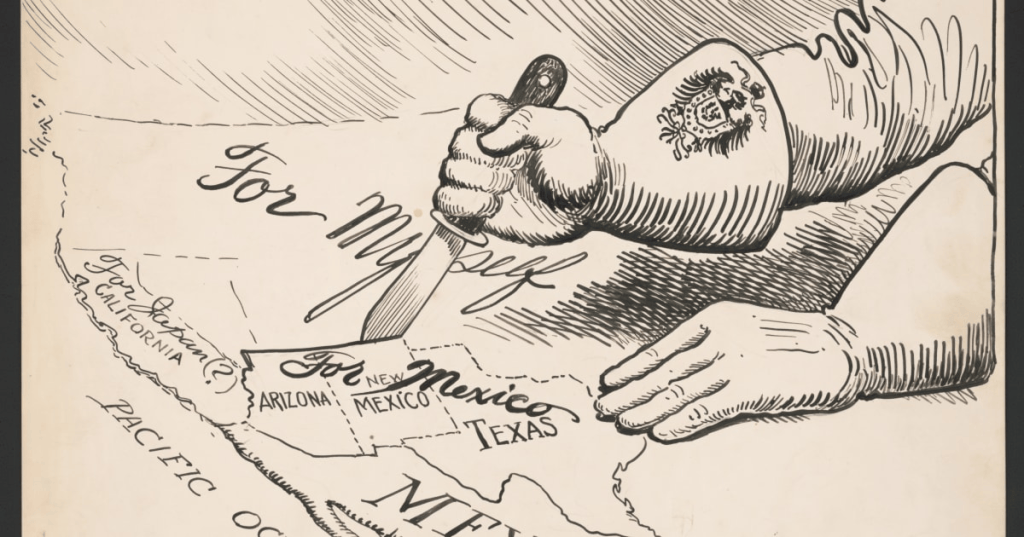
To distract the Americans and take them out of the picture, Germany considered bringing Mexico into the conflict. If Mexico would open a new front between themselves and the Americans along their common border Germany could concentrate their efforts on the continent. If the United States could be convinced to defend themselves, they might stop providing food and ammunitions to the Allied powers.
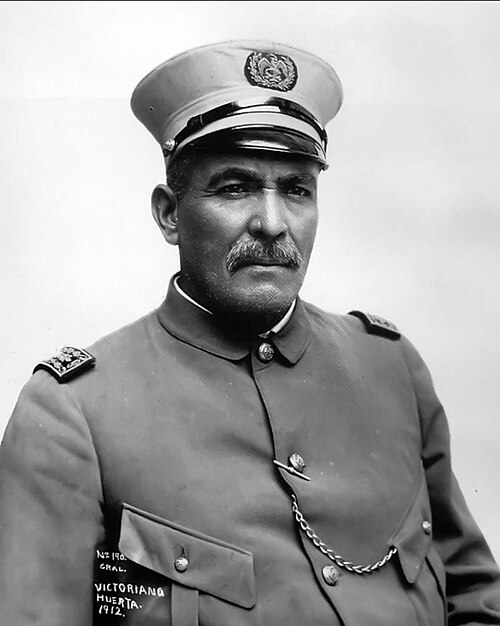
Even though the Americans had a pretty easy time defeating the ailing Spanish Empire in 1896, freeing Cuba and gaining the Philippines and other islands in the Pacific, they had ongoing difficulties with a Philippine insurrection (they wanted complete independence not another overlord.) Added to the mix of the Philippine issue was an ongoing skirmish between Pancho Villa’s forces and the US Army under General “Blackjack” Pershing along the border. Villa was involved in a civil war as one of three main parties to win approval of Mexico’s citizens for a new government after the fall of the Porfirio Diaz’s dictatorship. Emiliano Zapata and Victoriano Huerta led nearly equal forces to Villa’s troops to wrestle control for a new government. President Wilson refused to recognize the new government of General Huerta and ordered an invasion of US troops. By 1916 General Pershing was along the southern border searching for Pancho Villa’s troops. It turned out Pershing couldn’t find the Villa and his troops to engage them in a battle. Villa outwitted him and took mules and supplies from Pershing’s camp at night without ever being seen.
To the Germans it appeared the Mexicans could handle themselves against the Americans quite well. In January 1917 German Foreign Minister Arthur Zimmerman sent a coded telegram to the German Minister to Mexico, Heinrich von Eckhardt offering U.S. territory to Mexico if they would join the cause. The cable between officials within the German government was intercepted by the English before it was offered to Mexico. If accepted the offer would prove disastrous to Britian and the Allies.
The British knew the Russian government was weak, perhaps too weak to continue the fight. Their fears were confirmed in February 1917 when the Czar’s government collapsed and he abdicated. The prospect of the Russians suing for peace held the opportunity for the Germans to concentrate all their resources on the Western Front. Equally important was their failure to convince President Wilson and the Americans to commit to the Allied cause. Wilson had gone so far as to promise continued American neutrality during his 1916 presidential campaign. Lucky, British code breakers intercepted Zimmerman’s communication and deciphered it.
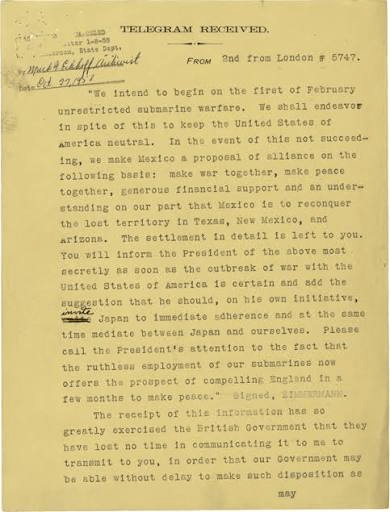
On February 24, 1917, the British sent a decoded copy of the telegram to the U.S. government. Timing, as they say, is critical. Ther Germans had just broken the Sussex pledge and resumed their policy of unrestricted submarine warfare. The telegram laid out their plans to increase their submarine activity. In anticipation of the U.S. joining the Allied powers because of the submarine’s expected damage, the German were reaching out to Mexico. The January 19, 1917, communication was all numerical, but England’s code breakers translated the sequence into German and then translated the contents into English. It started out:
“We intend to begin on the first of February unrestricted submarine warfare. We shall endeavor in spite of this to keep the United States of America neutral. In the event of this not succeeding, we make Mexico a proposal of alliance on the following basis: Make war together, make peace together, generous financial support and an understanding on our part that Mexico is to reconquer the lost territory in Texas, New Mexico, and Arizona. The settlement in details left up to you.”
Unrestricted submarine warfare led to growing animosity toward the Germans. News of the potential alliance and possible conflict along the United States southern border led the president to ask Congress for a declaration of war. The British gamble in releasing the contents of the telegram paid off!
Little did the Germans know that twelve months later they would successfully close the Eastern front with Russia by negotiating the Treaty of Brest-Litovsk which not only allowed them to send troops to the Western Front but provided the needed wheat from Ukraine and reparation payments to ease part of the economic burden of the war.
The Zimmerman Telegram played a critical part in bringing the United States into the war on the side of the Allied Powers. By November 11, 1918, the war would be over, in part because of U.S. troops and supplies. Would the Germans have been so anxious to reach out to Mexico if they had known? The first two years of the conflict had been disastrous, neither side was confident how long they could continue. Cementing an alliance with the only major industrial power was part of the overall conflict between the English and Germans. The Zimmerman telegram, never delivered to Mexico, turned out to be one of the pivotal events in the war’s outcome.
It turned out Mexico had no intentions of allying with Germany, according to the Council on Foreign Relations. Wilson used the telegram to turn down the heat between the nations, recognizing the new post-revolutionary government (reversing his policy regarding Huerta), removed the last troops from Mexico and sent an ambassador to formalize relations between the two neighbors.